Erection

I came this ‘ ‘ close to deleting an email I received this week with the subject line as above. I used to receive many such messages. Often accompanied by words like dysfunction, failure, problems etc. All the while extolling the virtues of some wonder pills guaranteed to make my wife happy. It’s well known in this household that a long trawl around a garden centre is far more likely to lighten Mrs TPAS’ countenance than anything I could swallow. I think. I hope!

Anyway, I have the curiosity of a small, hungry cat called Brian, and I noticed that this particular email also had a photo attached. So it is by the skin of all our teeth that I present to you this delicious telegraph pole courtesy of Euros Jones.

Euros is not one to waste words and the photo came with the simple caption:

Went through Aberangell last week and saw this pole being replaced.”

Aberangell is a village deep within the stunning gorgeousness of the Dovey hills, N.E. of Machynlleth. And just think what a coup it would have been had we also a photo of this old pole coming down and the new one going up as witnessed, alas uncaptured, by Euros. If I won the lottery I suppose I could always get them to re-enact it just for my not-at-all-obsessive benefit.

Anyway, I doff my cap firmly in Euros’ direction. He saw a pole being replaced and somehow managed to put his hands on the photo of it going up in the first place decades ago. I certainly couldn’t do that. And I don’t know many who could. Actually, I say I doff my cap, but truth is, the only headwear I ever wear is an Aberystwyth Town FC bobble hat. So next time I’m at the footy Euros, it’ll get doffed your way.

Black and white photo of a street scene in Aberangell, mid Wales, showing a GPO team putting up a four crossarm pole with great effort.

Russell is a Jerk

This is a tale from over there. Mike (whose surname never made it the 3,327 miles across the Atlantic) wrote to us from Seaside Heights, New Joizy wherein he is a lineman for an electric utility company. He sent us the photos you see below accompanied by the following missive:

“There once was a Lineman named Russ and a Telephone repair man called Tom. They were always playing jokes on each other, such as , if Russ saw Tom’s truck in town, he would go put dielectric grease on his door handle or his steering wheel or tool bin door or all three.


So Tommy made a sign with the stencil kit they use to make tags for the poles and that’s where this came from. I’ve been working here 20 years and I know Russ retired way before I started, so I don’t know how long that’s been here.”

This website and society leans, say, 95% towards Britishness, so over here a more relevant, accessible, phrase stenciled into a telegraph pole might be “Russell is a Knob“.

If you are at all affected by things you’ve seen or read on this page you should call “Hope & Healing” on 866-202-HELP

UK Patent #2522487

I’ve been rather lax in my updates of this good site lately. For which I apologise and for which I proffer excuses #3 & #12a. I realise that my tardiness in this respect has denied readers their regular ingestion of telegraphular intelligence but unless #12a *1 happens again, this neglect may or may not be repeated.

Now, Martin Cummins… There’s a man whose anorak is thicker than mine. Longer, stronger, more weatherproof, more anoracky, and with a rim of faux fur around the hood which serves no apparent purpose. Martin has dedicated almost his entire adult life to finding out what the little tubes are that stick up from the ground at the side of many telegraph poles.

My correspondence with Martin on this subject has been ongoing for many years and I feel it has reached zenith now as he introduces us to:

Front descriptive cover of UK Patent Application GB2522487 describing apparatus and method for measuring the depth of utility poles.

It’s funny how things seem so obvious once a UK patent application shows you how. But this doesn’t quite apply for me here. I’ve studied this document <read it in full here> and whilst, superficially it looks like it would be able to tell you how deep a pole was planted, I can just imagine that gauging pen snagging and snapping off at, if not the first, then the second, time you use it. This patent idea though does have the bonus in that it comes from God’s own country. I feel I ought to know the patentee.

A reminder of why we need “depthing tubes” in the first place came from John Scott to whom we are grateful. “These tubes have been fitted to the sides of poles since some silly pole installers decided due to digging and finding rock in their way, they would simply cut the butts off the poles and make it look like the poles were installed in the correct depth while some may have been installed less than a meter and thus endangering future engineers climbing the poles.”

Anyway, back to our original correspondent, Martin. I can’t help but wonder does he feel that life is complete – now that he’s found out what those little tubes are for what else is there? Such dogged determination needs a new purpose and I hope he finds it around the subject of telegraph poles.

Actually, here’s an idea. This conundrum Answers on a postcard please has been outstanding since 2012. Perhaps, Martin, you could dedicate the next part of your life to solving the “Saltpot Conjecture”. i.e. what the hell is one of these?

The world certainly needs tenacious folk like Martin Cummins. Anyway, he did also tell us about Basingstoke Museum, where they have an old GPO Maintenance Van, replete with everything to make you self-sufficient when lost in the Trossachs. It’s on my list of museums to visit before I die.

*1 #12a Abducted by aliens.

New Zealand P.O. Marital Aids

Low productivity levels among telegraph pole linesmen was causing serious concern among New Zealand P.O. bosses as the 1960s came to a close. Research led them to believe this was because of unhappy home lives and if they could somehow spice up marital harmony then this trend could be reversed.

A short-lived experiment ensued in which 120 pairs of No. 1 S&M kits were handed to linesmen across three districts: Rotorua, Auckland and Christchurch. They failed however to provide explicit instructions as to their intended use and the baffled pole engineers took them home to humour their bosses.

However by the end of the six month trial period productivity had actually increased in these key areas. Dramatically so in the case of Rotorua. It turns out that the enterprising linesmen had discovered that these fierce looking devices could be attached to their legs and thus enabled them to climb poles way quicker than they ever could using a ladder. Whilst the love lives of the workers hadn’t changed, their speed up a telegraph pole had accelerated four-fold.

Embarrassed bosses back-tracked and reported that this had been their intention all along and that “leg irons” should thenceforth be issued as standard to the workforce.

The set you see below was bought by Judy Pittman at a car-swap meet in Nelson, S. Island. She was delighted to learn the history of them from me but intimated she would be keen to sell them to any of our readers were interested in adding these fascinating love-aids to their paraphernalia collections. She would be happy to post to the UK but reports that postage would cost £36. If anybody is interested, do drop me a line to martin@telegraphpoleappreciationsociety.org and I will pass on your details.

Finally, Finials from Auld Reekie

Neil Bell sent us these photos of a fabulous phlogistonically finialed pole that he can see from his living room window. This has allowed me a few firsts: (i) The use of the term “Auld Reekie” – an affectionate term for the fair city of Edinburgh; (ii) the use of the term “phlogistonically” which at first sight would appear to be an adverb – i.e. turning an adjective into a verb with the suffix “ly”. But then the word phlogiston would be a noun, so here I’ve invented a whole new type of word which I will hereonin call an adnoun. Not only that but phlogiston is itself a made up substance in use before they discovered oxygen; and finally (iii) an extremely elegant and aging finial amid the rooftops of Connaught Place (EH4). You don’t get all this on the Cloud Appreciation website.

Anyway, I wanted to know how old this pole was – I see it has six notches for long-removed crossarms – these arranged four facing, and a further pair at 90 degrees. Neil couldn’t find any information in the vicinity of the doby mark other than those seen here – which I will now identify for his and posterity’s benefit. 61 is the pole number (plastic tags and also an iron 61 lower down) – a DP judging by all the subscriber dropwires radiating from near the crown. It was inspected in Feb 2017 by D.E.K. on a 6 yr periodic; but then again on 3rd October 2019 by the engineer with the evocative ID # 612026689. This visit we know from the new annotation method of hammering in a small white plastic tag at the foot of the pole. This particular pole tester thought it was still Monday and their appalling error of chronology is recorded forever not only at the base of the pole but also now on this website.

If anyone can tell us what the little gate hook is for in picture #5 then we’re all ears.

Poetic Circles

I move in some interesting circles, me. I know a man who spends his time counting ants, for instance. I’m on a nodding acquaintance with someone off a TV soap* and I once overtook Olympic swimmer Duncan Goodhew on the M6 near Walsall. All of that and I also count among my friends one of Britain’s brightest contemporary poets – Gareth Writer-Davies.

What the hell has any of this to do with telegraph poles? I hear you ask. Well GWD, as we call him, showed me this photo of a pole at Cilcennin in Ceredigion, and wondered would I be able to translate the stapled-on note. Not being averse to completely lying to look clever I said, “Of course… it’s a note from engineer CFSW etc. to pole visitors of the future that the wire needs to be upgraded to 0.6mm and that the other numbers are the eBay order codes and some pole sequence numbers.” Then, lying considerably less, I told him that this was a BT (Openreach) 9 metre medium pole and that it was creosoted by Burt Boulton & Haywood at Alexandra Dock, Newport in 2004. Er…. in April I think

I think I might just have made it on to his Christmas card list.

* Pobl y Cwm on S4C

The chiselled ID marks of a telegraph pole near Cilcennin, Ceredigion.

Telegraphular Treasure Trove

What a find. 

Openreach  (used to be called BT) works allocator Steve Sheppard - aka Shep*1 - is a collector of various vintage GPO paraphernalia and dug this old booklet out of his garage in Shepton Mallet to show the overhead/poling guys how it was in the good old days - when penny arrows really were a penny, when you could have a night out for under a shilling and when you could drive home with eight pints inside you (and when you could get killed by someone driving home with eight pints inside them).

Anyway, this is gold dust to we telegraph pole anoraks and also to railway and diorama modellers - who are always asking me for dimensions of such things (I always send them the numbers I find on the labels in my wife's underwear drawer).    We are incredibly grateful to Shep and may his work allocation*2 always be fruitful.  Thanks Shep, these are fabulous.  Enjoy.

*1He's known as Shep not, as you might think, because of his surname, or because he's from Shep-ton Mallet, but rather because of his erstwhile obsession with John Noakes' dog.
*2 Whatever the hell that is!

Openreach employee of the month

Normally this award would be given to the Openreach employee who most recently fixed my phone line or got my internet going again. But for August 2019 a TPAS Order of Merit (see right) has been specially minted for us to give to Wayne Firth.  Wayne used to be a ringer-of-wood and laddersman trapeze artist in the alfresco world of telegraph pole inspecting.  Now, though, his hands are clean and splinter-free, his collar only slightly grubby and his life a whirl of acetate overheads and powerpoint system crashes in the murky world of the office interior as he trains up tomorrow's pole rattlers.

Wayne kindly sent us the collection of photos of poles, various, that you see below.   3 pics of extremely hirsute poles, 4 photos of pole stacks - where all the different types of pole are laid out in their categories before being selected for installation and finally a pole/tree hybrid that he found out on his rounds. This is a tree that is growing completely around the pole itself.

One final thing.  Wayne didn't say where he was from, but judging by the fact that every one of these photos it seems to be soaking wet from recent rain I would say he must be from Blaenau Ffestiniog.

The view from on high.

posted in: Engineers

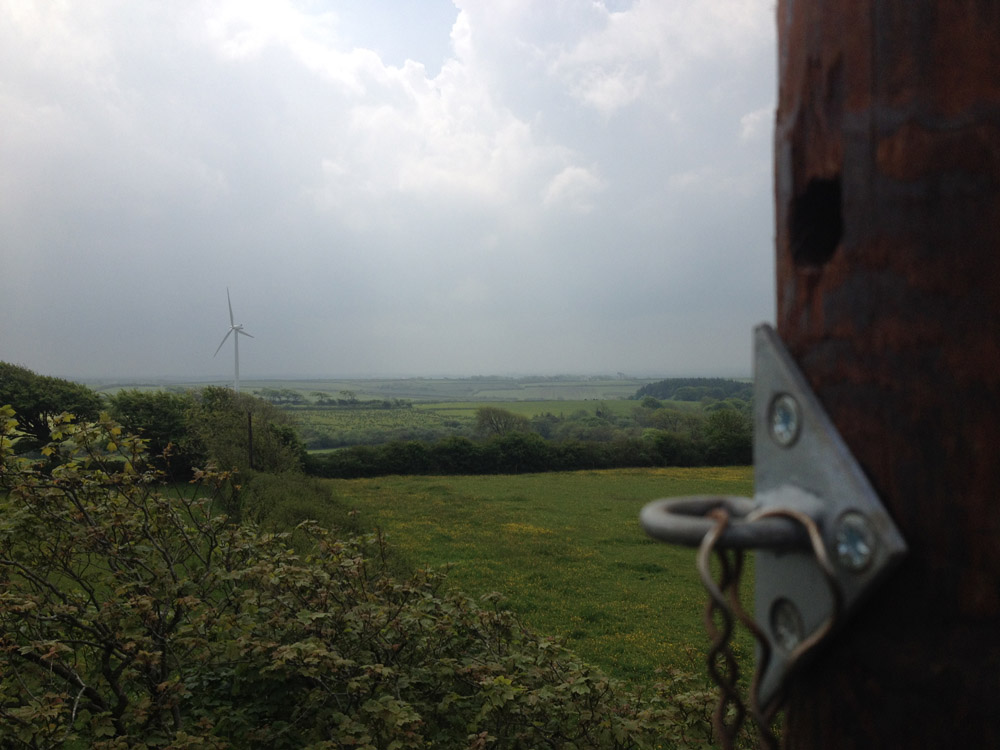
When John Brunsden, #0469H, comes on here he is on something of a busman’s holiday.  For John spends his working day at altitude – approximately 10 metres above the ground to be approximate.  With a proper footed ladder, guy ropes, hard hat, high viz, crampons and butty box it’s a wonder he has the strength to get up there.  Anyway whilst atop the ladder he does get time to ponder the wonders of the universe, the meaning of life and what is on the other side of that pole:
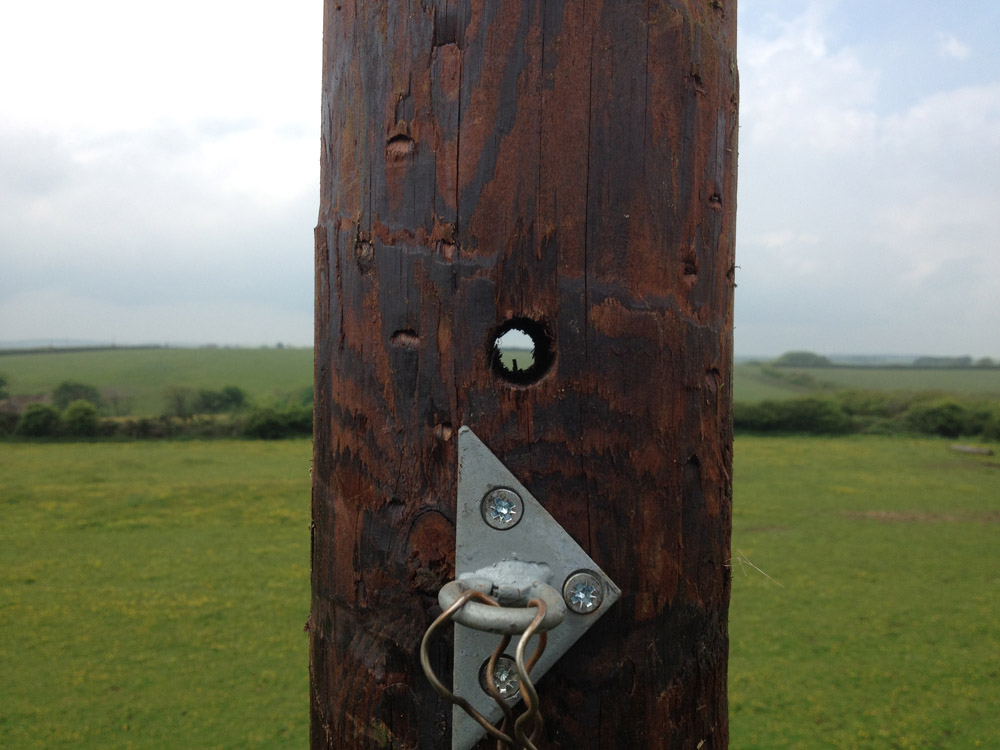
…bit bored waiting for the dropwire to be passed up to me, to attach to the pole, so took this pic of the view through a brand new pole hole into Cornwall from just over the border in West Stowford, Devon.

IMG 0555 IMG 0555 IMG 0555

of leaning poles and other animals

posted in: Engineers

Intermittently regular correspondent, David Kendrick (#0609H) has explained his recent dearth of communiques.  Not a sign of incipient polophobia he assures us.  By way of proof he has sent us the picture you see below of the leaning pole of Morville (Salop).  Found in the village hall car park.  Morville being famous for a book my wife once read called “The Morville Hours” by Katherine Swift – about a garden I got dragged around a couple of years ago.  My sulk lasted almost a full week after that.  And “Salop” being ye olde name for the county of Shropshire.  People like me, and David Kendrick I presume, refuse to give it it’s modern name much preferring the owd word Salop.  Salop, being the county wherein I also formed a society to maintain a stout postulation of Phlogiston theory.

Anyway, David Kendrick, no, this could never qualify as a Pole of the Month because it has its head buried in the hedge.  We like to see its face.

The second photo he sent us is of an array of pole engineers’ climbing equipment at the Kidderminster Railway Museum where he is a volunteer archivist and trainee boring old fart.  I can’t help but wonder what one goes on to be once graduated from this latter training course. 

With regard the second photo.  Through the wonders of internet technology, if you look away from the table full of tools for 10 seconds, then look back again, you will find I have removed one of the items.  You pass the test if you can tell me which one it is.

A leaning pole at Morville in Shropshire

A table full of pole engineers' equipment.


1 2 3