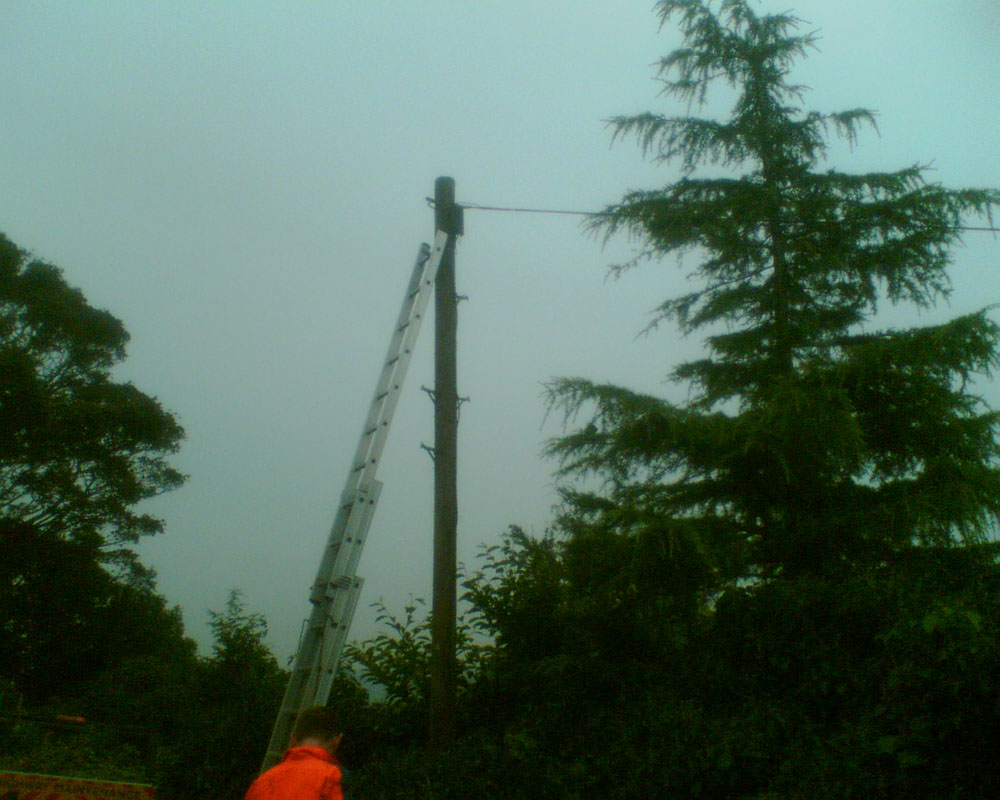
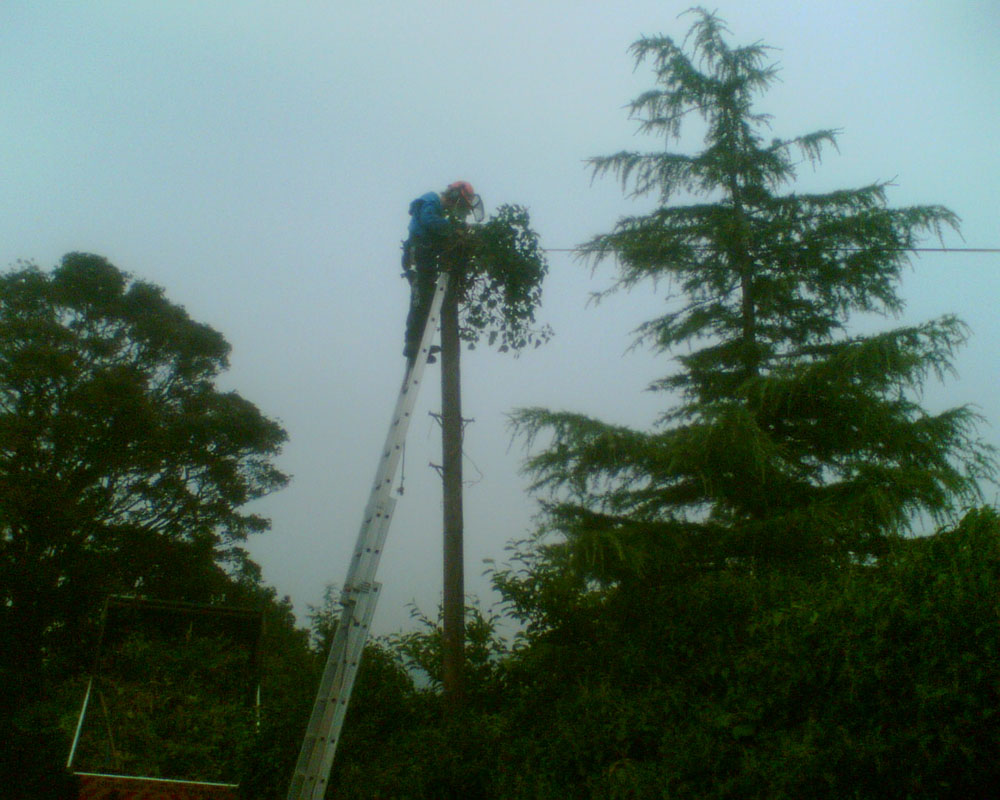
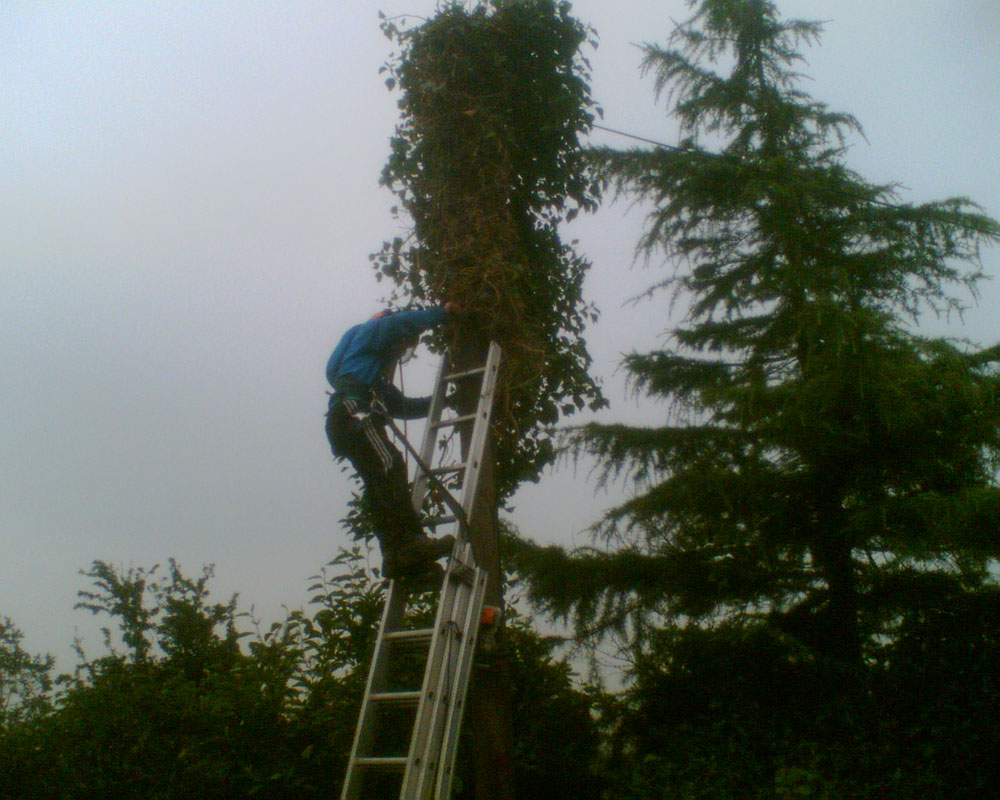
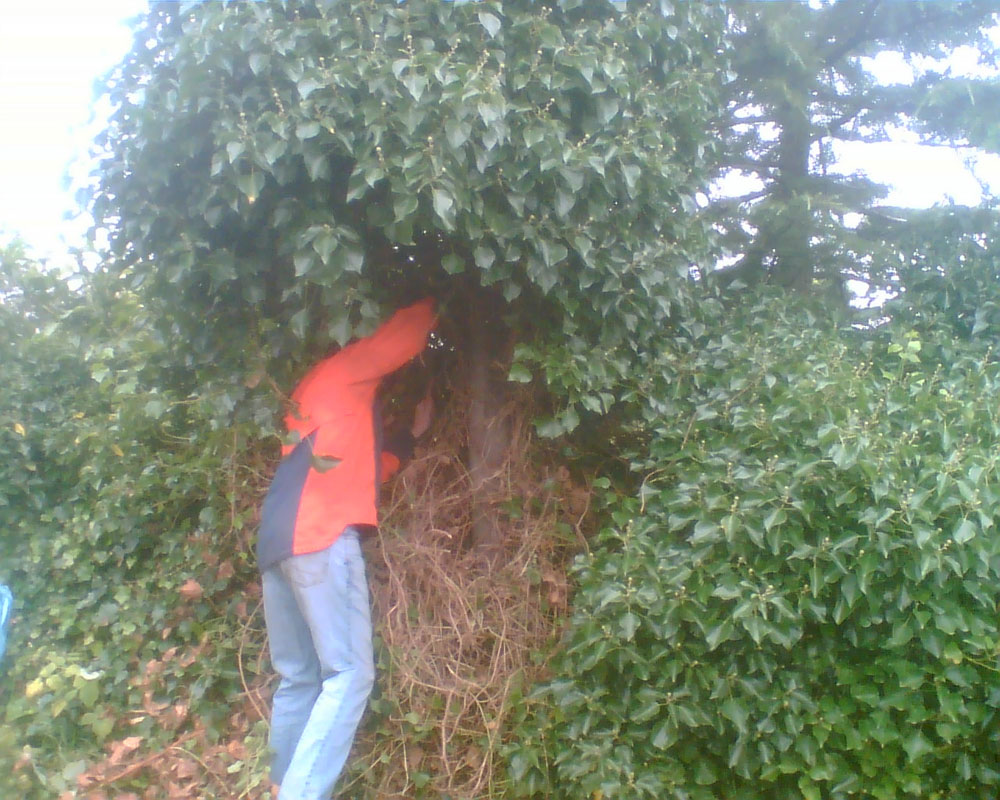
Laurence Langley wrote to tell us of his new role – that of responding to Openreach’s hazardous equipment within 2 hours! And herewith one of his more interesting poles.
“This pole feeds the entire island and due to the river crossing & boats the pole is 15m to avoid collision. TW17 9LN – DP107 CP1 – 15m Medium. The only access to the island is by barge and will require a crane to transport the pole across, if the Water Authority do not require the current wire height then we would be looking at a 10m hollow pole, this would save us transporting and will be easier to install the pole.”
Apologies for the low-resolution of the images. WIGIWYG (What I get is what you get)
NB. The value of an outside loo from one of those properties would probably be five times what my house is worth. And I live in a castle. In Wales.
I’ve been rather lax in my updates of this good site lately. For which I apologise and for which I proffer excuses #3 & #12a. I realise that my tardiness in this respect has denied readers their regular ingestion of telegraphular intelligence but unless #12a *1 happens again, this neglect may or may not be repeated.
Now, Martin Cummins… There’s a man whose anorak is thicker than mine. Longer, stronger, more weatherproof, more anoracky, and with a rim of faux fur around the hood which serves no apparent purpose. Martin has dedicated almost his entire adult life to finding out what the little tubes are that stick up from the ground at the side of many telegraph poles.
My correspondence with Martin on this subject has been ongoing for many years and I feel it has reached zenith now as he introduces us to:
It’s funny how things seem so obvious once a UK patent application shows you how. But this doesn’t quite apply for me here. I’ve studied this document <read it in full here> and whilst, superficially it looks like it would be able to tell you how deep a pole was planted, I can just imagine that gauging pen snagging and snapping off at, if not the first, then the second, time you use it. This patent idea though does have the bonus in that it comes from God’s own country. I feel I ought to know the patentee.
A reminder of why we need “depthing tubes” in the first place came from John Scott to whom we are grateful. “These tubes have been fitted to the sides of poles since some silly pole installers decided due to digging and finding rock in their way, they would simply cut the butts off the poles and make it look like the poles were installed in the correct depth while some may have been installed less than a meter and thus endangering future engineers climbing the poles.”
Anyway, back to our original correspondent, Martin. I can’t help but wonder does he feel that life is complete – now that he’s found out what those little tubes are for what else is there? Such dogged determination needs a new purpose and I hope he finds it around the subject of telegraph poles.
Actually, here’s an idea. This conundrum Answers on a postcard please has been outstanding since 2012. Perhaps, Martin, you could dedicate the next part of your life to solving the “Saltpot Conjecture”. i.e. what the hell is one of these?
The world certainly needs tenacious folk like Martin Cummins. Anyway, he did also tell us about Basingstoke Museum, where they have an old GPO Maintenance Van, replete with everything to make you self-sufficient when lost in the Trossachs. It’s on my list of museums to visit before I die.
Low productivity levels among telegraph pole linesmen was causing serious concern among New Zealand P.O. bosses as the 1960s came to a close. Research led them to believe this was because of unhappy home lives and if they could somehow spice up marital harmony then this trend could be reversed.
A short-lived experiment ensued in which 120 pairs of No. 1 S&M kits were handed to linesmen across three districts: Rotorua, Auckland and Christchurch. They failed however to provide explicit instructions as to their intended use and the baffled pole engineers took them home to humour their bosses.
However by the end of the six month trial period productivity had actually increased in these key areas. Dramatically so in the case of Rotorua. It turns out that the enterprising linesmen had discovered that these fierce looking devices could be attached to their legs and thus enabled them to climb poles way quicker than they ever could using a ladder. Whilst the love lives of the workers hadn’t changed, their speed up a telegraph pole had accelerated four-fold.
Embarrassed bosses back-tracked and reported that this had been their intention all along and that “leg irons” should thenceforth be issued as standard to the workforce.
The set you see below was bought by Judy Pittman at a car-swap meet in Nelson, S. Island. She was delighted to learn the history of them from me but intimated she would be keen to sell them to any of our readers were interested in adding these fascinating love-aids to their paraphernalia collections. She would be happy to post to the UK but reports that postage would cost £36. If anybody is interested, do drop me a line to martin@telegraphpoleappreciationsociety.org and I will pass on your details.
I move in some interesting circles, me. I know a man who spends his time counting ants, for instance. I’m on a nodding acquaintance with someone off a TV soap* and I once overtook Olympic swimmer Duncan Goodhew on the M6 near Walsall. All of that and I also count among my friends one of Britain’s brightest contemporary poets – Gareth Writer-Davies.
What the hell has any of this to do with telegraph poles? I hear you ask. Well GWD, as we call him, showed me this photo of a pole at Cilcennin in Ceredigion, and wondered would I be able to translate the stapled-on note. Not being averse to completely lying to look clever I said, “Of course… it’s a note from engineer CFSW etc. to pole visitors of the future that the wire needs to be upgraded to 0.6mm and that the other numbers are the eBay order codes and some pole sequence numbers.” Then, lying considerably less, I told him that this was a BT (Openreach) 9 metre medium pole and that it was creosoted by Burt Boulton & Haywood at Alexandra Dock, Newport in 2004. Er…. in April I think
I think I might just have made it on to his Christmas card list.
Pop into the stores department at an Openreach depot down there in Somerset (precise location redacted), ask for Andy the storeman and give him the coded phrase “I’d like something for the weekend please”. Said storeman might then reach under his counter and pull out a pile of well thumbed glossy magazines. And if you’re especially lucky, like regular correspondent and top TPAS agent #0469 John Brunsden, one of those greasy mags – slipped your way – might just be a copy of The Post Office Electrical Engineers Journal from January 1939.
Using a camera cunningly concealed in his mobile phone, agent #0469 hastily snapped off a few of the pages and emailed them to us. I present you now delectable, collectible selection of eclectic photos from this amazing tome. It was with particular mirth that agent #0469 and storeman Andy pored over the man with trilby up pole on p5. Rightly so. Thank you John & Andy
Openreach (used to be called BT) works allocator Steve Sheppard - aka Shep*1 - is a collector of various vintage GPO paraphernalia and dug this old booklet out of his garage in Shepton Mallet to show the overhead/poling guys how it was in the good old days - when penny arrows really were a penny, when you could have a night out for under a shilling and when you could drive home with eight pints inside you (and when you could get killed by someone driving home with eight pints inside them).
Anyway, this is gold dust to we telegraph pole anoraks and also to railway and diorama modellers - who are always asking me for dimensions of such things (I always send them the numbers I find on the labels in my wife's underwear drawer). We are incredibly grateful to Shep and may his work allocation*2 always be fruitful. Thanks Shep, these are fabulous. Enjoy.
*1He's known as Shep not, as you might think, because of his surname, or because he's from Shep-ton Mallet, but rather because of his erstwhile obsession with John Noakes' dog.
*2 Whatever the hell that is!
Just look at this amazing sequence of photos. These were captured by our underground and underwater agent, Adrian Trainsett (#0484). They provide proof positive that, as long suspected, BT are concealing telegraph poles the length and breadth of Britain.
What started out as a perfect saucy pole in the countryside near wherever this is, gets slowly covered over by foliage which the engineers brought with them and can be clearly seen in their truck in picture #3.
08:55am
A BT inspector arrives to check out this perfectly saucy pole in the countryside near wherever this is.
09:25am
After a refreshing cup of tea in the BT Openreach van and a read of the Daily Star, said BT inspector climbs the ladder and attaches the first bundle of foliage to the top.
10:47am
Two more tea-breaks, a quick look at the sudoku another fag and then back up the pole to nail up more tree stuff.
Truck load of foliage can be seen waiting to be attached.
11:55am
They’re nothing if not meticulous. More tea, a nip off to the shop for some pasties and a twix then back to the job in hand.
The foliage has to be fitted properly otherwise it won’t look convincing.
1:22pm
Very little left to see of the original pole. A whole skip load of foliage has been attached to this pole and 18 cups of tea consumed.
2:37pm
The afternoon tea break is very short. They realise they’ve taken the mick a bit too far and they’ll end up having to work over.
Just the finishing touches now though. Time for one more cup of tea, a fag, a biscuit and a quick shufty at that mag Terry brought before buggering off home.
3:22pm
That’s it, job done! Hop back into the van, throw all the crisp packets and pop-bottles into the hedge and drive off back to the depot.
Another telegraph pole covered over to spare the blushes of sensitive ladies who may be passing and aroused by such things.
British scientist, Dr. Aubrey De Grey recently declared that the first person ever to live to be 150 years old has probably already been born.
Then along comes the telegraph pole equivalent of Glucosamine, and now there’s every chance that our beloved telegraph poles will reach a similar age.
According to Honorary Technical Adviser Keith S****, a well treated telegraph pole is already capable of making it to its 100th birthday. But the main vulnerability is the point the pole meets the ground where conditions for decay and rot are ideal – substantially shortening its useful life. That’s where Polesaver come in. Their patented polesaver barrier sleeve system protects a utility pole at this point of contact – saving you up to £3,000,000 a year*1. Wow ! I’ll have some of that. Anyway, with that kind of dedication to saving telegraph poles, how could they not be friends of this society.
Meanwhile, should my septuagenarian neighbour be the first person to make it to 150, then at his present rate of driving his 1961 Morris Traveller ever slower into town, I reckon that by 2050 he will have more than a million cars tailing back behind him.
I came upon this rather tired looking pole in an equally tired street in Fairbourne, Gwynedd. But according to the notice pinned to it, this pole is part of the Openreach Pole Inspection Project.
That all sounds very exciting and got me to speculate about the logistics and organisation of such a project. I wonder do a delegation of Openreach’s be-suited, be-spectacled executives gather at a conference centre at some place like Bristol? Appointing project managers, approving budgets, and discussing contingency plans. Whiteboards, powerpoint and balderdash?
And afterwards, does each delegate get to keep their name badge as well as a goody bag of project pencil, notepad and fact-sheet sticker packs? Then it’s off home to regale their respective spouses with stories of tea from a pump flask, how Derek couldn’t work the telephone conference gadget, and how the biscuits were probably Marks & Spencers, but had gone soft because they were put out too early.
Red category ‘D’ pole means it’s buggered by the way.