

These much ignored pieces of rural and urban furniture finally have a website of their own.
 This is not the site to visit for technical information pertaining to telegraph poles. You'll find nothing about 10KVa transformers, digital telephone networking or even so much as a single volt. This is a website celebrating the glorious everyday mundanitude of these simple silent sentinels the world over. We don't care what the wires contain either. They all carry electricity in some way be it the sparky stuff which boils your kettle, or the thinner stuff with your voice in it when you're on the phone.
Telegraph Pole Appreciation Day
We can’t quite run to the £27,000,000 that Danny Boyle blew on the olympic opening ceremony. But we do have a Roman Candle left over from last year and I think there’s a pack of sparklers under the stairs somewhere. Yes…
21st September
is
Telegraph Pole
Appreciation Day
This is a day when we finally look up and notice one of these unseen upright silent sentinels, be it a telephone pole or an electricity pole. All year long, and in all weathers they perform their duties unflinchingly – holding aloft the wires carrying your telephone calls to your cousin who’s just got engaged; or keeping up the wires delivering the electricity that makes your slim-o-matic adjustable vibrating tv lounger work. All in a day’s work for a telegraph pole.*1

 So, why not organise your own little celebration underneath your local pole. Maybe have a mini one-person street party with bunting and butterfly cakes and a bottle of pop with a wasp in it. Or maybe you’re the quiet pensive kind, in which case, just find a pole and gaze upon it in a whimsical needy kind of way – that’s exactly what I’ll be doing this Friday.
To help you get in the mood, why not visit last year’s posting about this special day and print off the postcard therein. And tell others about the wonder of telegraph poles while you’re at it.
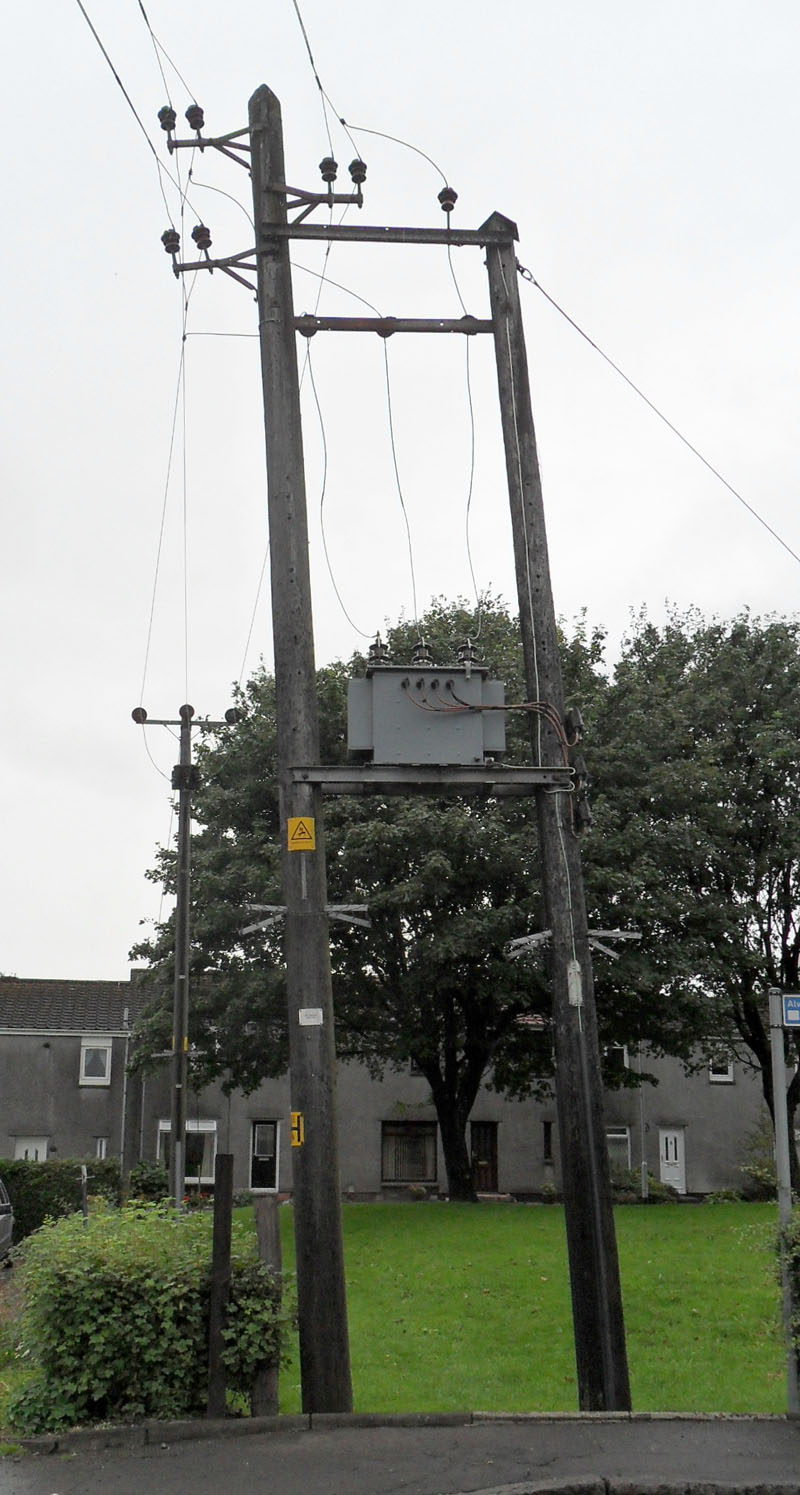
Meanwhile, if you can’t find a pole of your own, here’s a couple of needy ones that are worth celebrating. The first is from the lane to Borgie Hotel, off the A836 a few miles west of Tongue, Sutherland. Just think how splendid this would have looked in its heyday. Secondly, an eclectic electric pole which caught my eye at a village called Tillicoutry. A place so unheard of that even the locals just call it “look, it’s on the A91 near Stirling”.
*1 See Disclaimer, telegraph vs electric pole
Extreme Daughter Pole
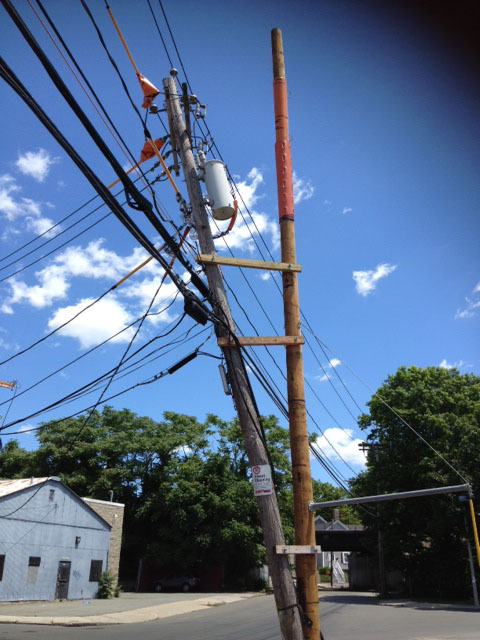 The first ever transatlantic radio message between the United States of America and Great Britain originated in Massachusetts in January 1903. That was from Theodore Roosevelt to King Edward VII to say that he was on the train.
Meanwhile, the first ever telegraphic email message between Massachusetts and our HQ in mid Wales occurred 109 years later, in July 2012, and was from a discerning sparky called Carter Wall containing news and a picture of an interesting telegraph pole.
Hi, I work for an electrical contractor in Boston, Massachusetts, and have always been a pole fan – particularly what we call “daughter” poles, where an old pole is strapped to a new one, rather than moving all the utilities from one to the other. This is a rather extreme version of a daughter pole.
Carter Wall
The words “blinking” and “marvellous” come to mind. Carter also kindly provided an internet link by way of anwering Dan Selby who posted back in April that he was looking for a manual on a KS-19935 L7 Test Set. Well, here you go Dan. Thank you Carter.
All in a day’s work here at the Telegraph Pole Appreciation Society.
Pole of the Month – September 2012
Martyn Fielder from… nobody ever says where they’re from… made me blush this week…
What a delight to discover your most enlightening website. I had never previously given much attention to the aesthetic properties of telegraph poles but your well constructed and wonderfully informative pages have opened my blind eyes to hitherto unappreciated beauty.
Normally I pay close attention to my feet while walking outdoors for fear of treading on the cracks in paving stones, but you have enabled me to overcome this phobia and now I walk with head held high admiring the silhouettes against the sky whenever they let me out.

Glad to be of service, Martyn. That’s what we’re here for. He continued…
In fact I am very eager to contibute to your pages – I have a wonderful submission for the pole of the month archive (from Africa!) Please let me know how I can send you a file*1 and I promise you will not regret it.*2
Then the photo arrived…
As you’ll see the attraction here is not so much the pole (at least to my untrained eye) as the lack of planning by the builders. I took this picture a few years ago during the construction of a new container storage depot opposite my office in Dakar, Senegal. They eventually moved the pole.
Seems a tad unfair to me – the pole was there first. Anyway, a worthy P.O.T.M. if ever there was.
Meanwhile, I’m off on my jollys to the fabled land of the telegraph poles once more. I’ll also be trying to check out whether, as Graeme Wallace reported, in Scotland Telegraph Poles can be found predominantly in the back of gardens whilst in England they are in the front. More to come on this.
Anyway, back in a fortnight. If you must break in while I’m away, spare me the broken locks please – the key’s under the mat.
*1 we did *2 we didn’t
FREE TO A GOOD HOME

We received a very kind offer today, from Nyree Phillips. Her father, who passed away recently collected a lot of interesting things, including the six ceramic insulators you see here. Sure that her father would be happy for them to go to a good home she offered them to us. As I explained to Nyree, whilst not specific about which parts of me she would remove with the scissors, my wife heartily recommends that I don’t bring home any more bits of old telegraph poles just yet. And not being able to think of any parts that wouldn’t hurt if removed with scissors, I thought it better to pass the offer on to our telegraphic readership.
So, if you can collect from Aylesbury, Bucks then all the better (and free-er) otherwise you would just need to provide an address and compensation for the postage which would be the order of a few pounds only for the chance to complete your telegraph pole cross-arms restoration project. Besides, mine are finished. Drop us a line if you are interested and willing to collect/pay postage and we will put you in touch with Nyree.
Thank you Nyree for thinking of us.
Fine GPO Specimens
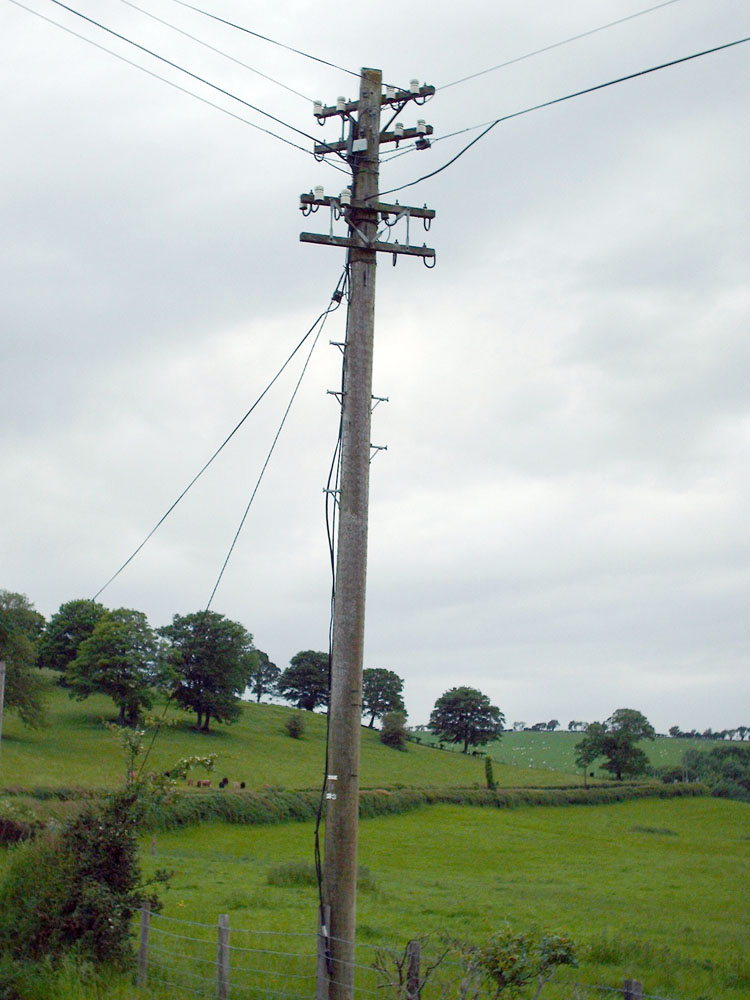
Now here’s something to warm your cockles on this wet and wintry August day. The first three of these poles I am familiar with as they are from the A543 Denbigh to Pentrefoelas moors road. They were kindly sent in by regular reader, Welsh Highland Railway volunteer, TPAS member #0449 and all-round good egg, Malcolm Hindes:
Along the fast stretch between Glanygors and Bylchau is a long lonely row of armless poles, nearly all with top-mounted double spindles (the type I usually refer to as “antlers”), some still with insulators.
However the real fun comes further east. Dropping down from Bylchau is a run of good bog-standard 2-arm poles, mostly in excellent condition and complete with insulators. My first photo is of one of these, with a lovely strut, near the bottom of the hill at map ref. SJ 001642, about 3 miles from Denbigh.
The next pole down (second shot) has crossarms at right angles for a spur up a side road (which I suspect is the old road), and alongside that same side road is a real beauty, crossarms at right angles again, double-J spindles, antlers and everything but the kitchen sink.


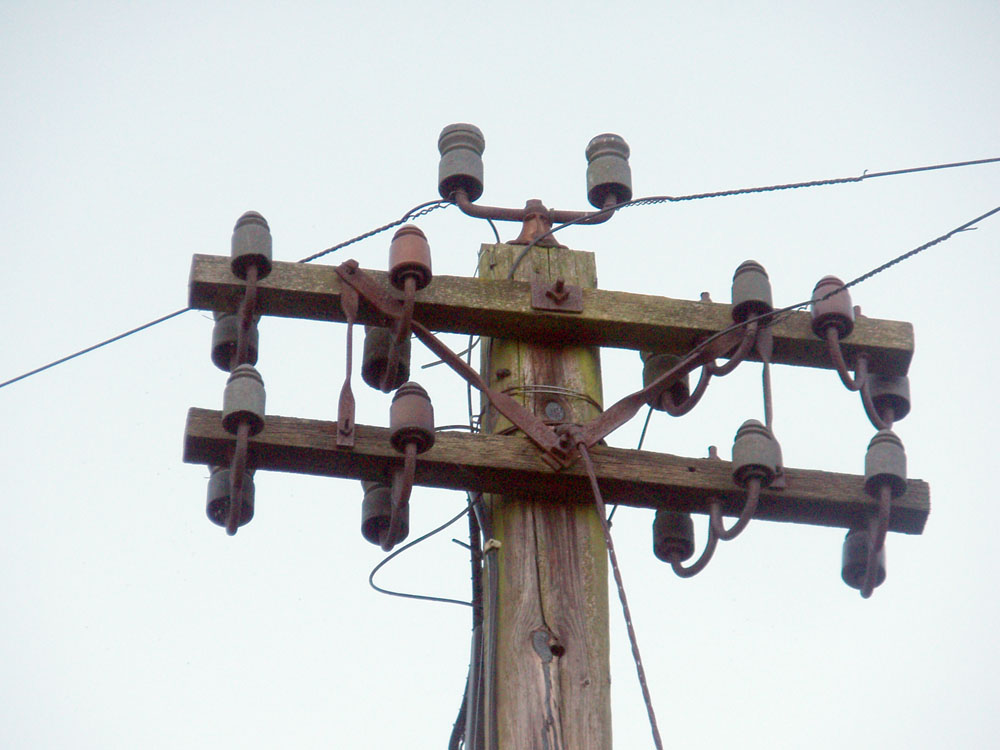
This next photo is from another GPO pole connoisseur, Graeme Fisher. This double crossbar number from opposite Wollescote Park, Stourbridge. I suspect that Graeme has potential as a rich-source of good pole photos – watch this space. Meanwhile, it would be remiss of us not to give his most interesting website www.drillhalls.org a plug.
Pointing the way to London
 Some eccentric telegraph pole related folklore has come to my attention recently…
Peter C. Nutt started the ball rolling with this letter:
I’m sure I read somewhere many many years ago that the cross bars on a telegraph pole are always on the side facing London. Any truth in this? I think I read this in a book which had something to do with hiking in the country, saying keep this in mind should you ever get lost. Though I can’t see it being correct myself.
Then, this week Mick Hughes from Pipex wrote :
My father was a lorry driver when I was a lad and would tell me that when finding his way coming onto a main road the crossbars on a pole were always put on the side facing London. Is this true? He passed away some time ago so I can’t ask him.
Well, I’m a great believer in the old adage that there’s no smoke without fire. And two people coming up with this notion means that it absolutely must be true. So to ensure the correct propagation of this interesting myth I shall, here on these esteemed pages, categorically confirm that it is true. Not only is it true, though, but the crossbars are actually aimed, using a sextant or something like that to face towards GPO Post Office Tower, 60 Cleveland Mews, London W1 T6.
You couldn’t make it up!
Distant Writing
H aving been asked a question about when telegraph poles first appeared I decided to do some research. And for the want of a good book, I trawled the world wide interweb…
I went right back to the birth of the telegraph as a form of communication, in fact to the first use of the term telegraph from the Latin tele meaning distant, and graphos, writing. I read about the earliest static electricity transmission experiments by Francis Ronalds and how the technologies improved and matured through the patents of messrs Cooke and Wheatstone to the first poles appearing alongside railway lines ca. 1843 – before then, telegraph cables had been bundles of cotton and tar coated wires contained within iron tube conduits and either buried or suspended just above the ground alongside railway tracks.
Why am I telling you all this – it is all to be found on one amazing website – a sort of eBook called “Distant Writing” by Steven Roberts. This is a fantastic and detailed history of the telegraph and associated apparatus – including telegraph poles. Go there and read it now.

Snow in Kent
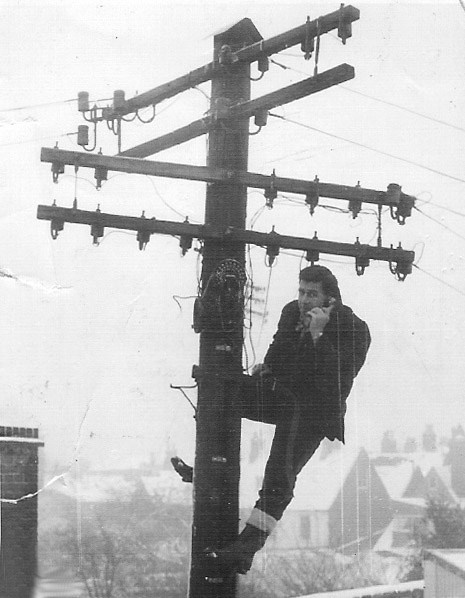
This just has to be my favourite telegraph pole photo of all time. It’s got everything… Firstly an esteemed member of this very society: namely Ronald Coleman (#0481) , now 85, who started his career as T2a Telephone Engineer rising to Technical Officer, Special Faults by the time he retired. He will have been up more poles than I have had hot dinners, cold ones, and all the lukewarm ones in between.
Ronald has fond memories of telegraph pole ceramic insulators as he says they made great impromptu tea-mugs.
This photo also features exceedingly rare, though once common, wide arms wood as well as insulators that actually have tied off wires.
And it was taken in Canterbury – the population thereof might well wonder what that white stuff on the roofs is – it’s called snow – and we get it up north and you used to get it in Kent too in those days. Yes, really!
So there’s Ronald on the phone to someone – when he should be fixing things – up a pole, no helmet, no gloves, just a pair of wellies and a donkey jacket – they were made of tougher stuff in those days. I have a friend who’s a health and safety officer, and I think it might just prove too much for him if he saw this though.
I bet Ronald only has to look at the tarry splinters embedded forever in his hands and it’ll take him right back. Special thanks to daughter Lynette for sending it in.
Oh, and one last question… Where the hell’s the photo taken from?
Pole Smash
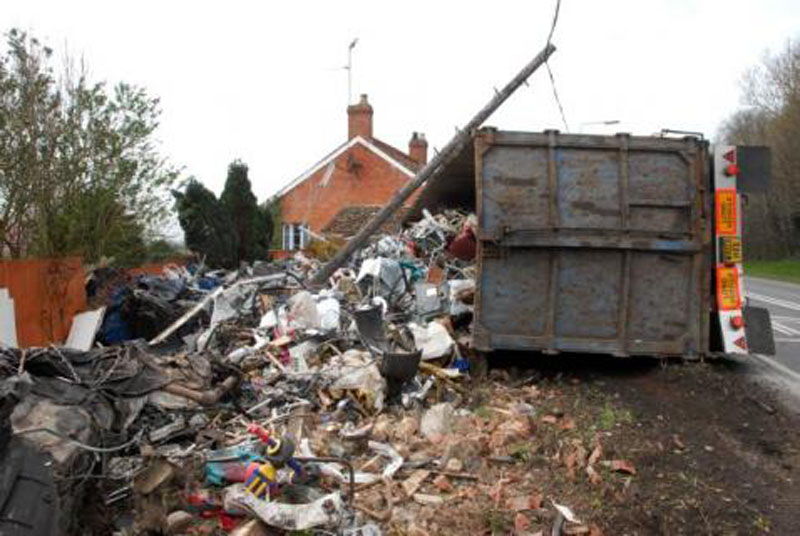
My first thought when the email containing this photo landed on my metaphorical doormat was… Why has somebody sent me a photo of my daughter’s bedroom? And why does she have a lorry in there? I’m going to have to have a word with that girl! Then I read the accompanying text. Telegraph Pole erector, fixer and photographer #0469 John Brunsden had been called to this unfortunate incident near Bridgewater in Somerset. Relieved that he only had to renew the pole and not tidy up beforehand. Then not tidying up seems to be my daughter’s attitude too – so long as the door will still open, what’s the problem?
Anyway, I can probably hear John Brunsden thinking “Blimey, that T.P.A.S lot are slow – I sent them that photo yonks ago!”. Well, we move in geological timescales here at TPAS HQ, and are of the opinion that everything comes to he (or she) who waits. Except perhaps getting the hoover into H’s bedroom!
Insulator Collection

Some time ago, Telegraph Pole Ceramics collector Jack Nesbit asked me about crossarm measurements. Furnished with said information he went off and constructed a display pole for his new insulator collection. See picture, and see more at the British Insulators website.