These much ignored pieces of rural and urban furniture finally have a website of their own.
This is not the site to visit for technical information pertaining to telegraph poles. You'll find nothing about 10KVa transformers, digital telephone networking or even so much as a single volt. This is a website celebrating the glorious everyday mundanitude of these simple silent sentinels the world over. We don't care what the wires contain either. They all carry electricity in some way be it the sparky stuff which boils your kettle, or the thinner stuff with your voice in it when you're on the phone.
The Cycle of Life
Duncan Collett has been busy dismantling his old barn down in Somerset. Judging by the photos he sent us it caused him to think seriously about the cycle of things. Herewith the barn itself and also the old GPO poles used in its original construction. Then he includes a photo of a brand new 8 metre "M"edium pole along the lane by his house. He also assures us that the old poles will be recycled again into a new smaller barn. This all sort of gives me a warm glow inside. That could also just be the Weetabix Vindaloo I had for breakast.
Telegraph Pole Perambulations in Wooler
Wooler, I just looked it up, is in Northumberland by the Cheviot hills, which have always sounded very enticing.
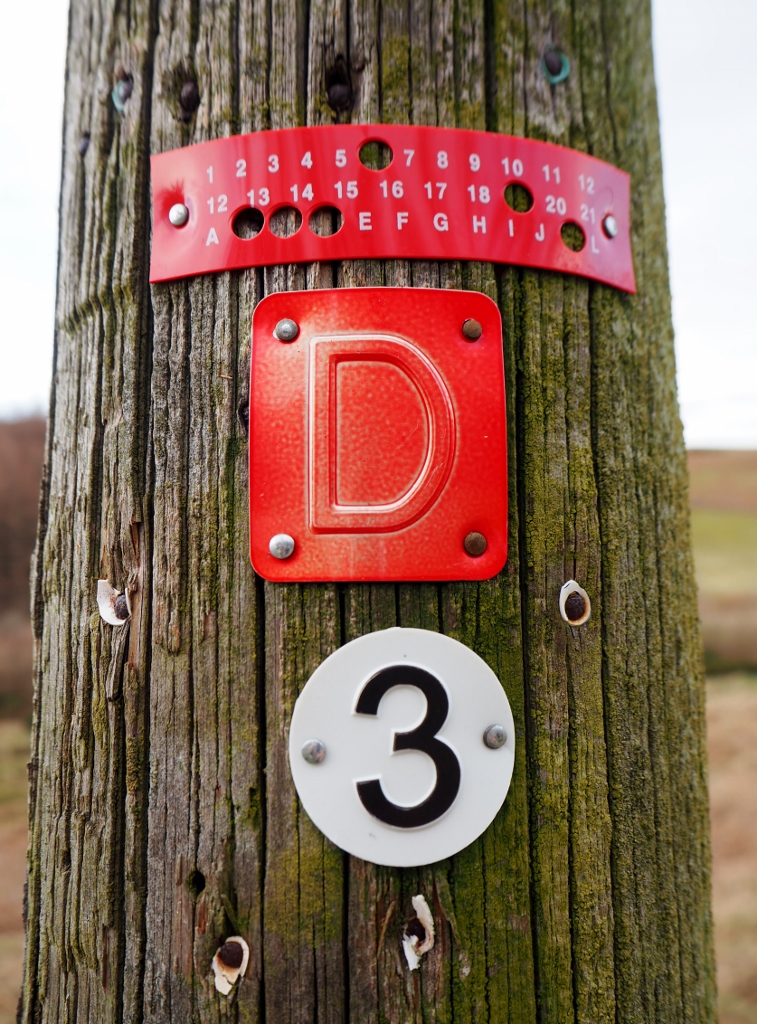
Anyway, Charlie Brown, member #0920 has been taking great advantage of his membership of this sage and august society by applying telegraphpoleology to his country perambulations. And whilst walking up to Wooler Common last weekend*1 with his grandchildren - Iris & Otto (now members #0926 & #0927) - they bagged a trio of 24ft light poles from 1935.
"In good shape", he tells us, "but leaning a bit hence the D plate and a legible explanation on the A1024."
"Nonetheless they are still doing their job and one can only admire the preservation process from 85 years ago. It was fun to spot*2 and a nice bit of telecommunication history."
He tells us he's enjoying his membership immensely and his GC's (as he calls them) have really taken to it. They have soul - our future is bright.
*1 Email dated pre-Corona lock down before any narks decide to call the police.
*2 Luckily, he had his very informative copy of Telegraph Pole Appreciation for Beginners to help him here.
Motion blurred Aussie Poles
Olde Pole along the Cuckoo Line
Anyway, Matt also reckons he’s heard, off a man who knows a man that BT are thinking of getting rid of all telegraph poles by 2030. Is this true? He asks. Over my putrefying, maggot riddled corpse I say. So, yes, probably Matt.Wales’ newest pole
Much excitement down our lane this week. So much so that a statistical blip of reduced-productivity appeared, albeit briefly, on national audit spreadsheets calculating GDP. This is a story of a pole replacement operation. The twin poles of the bend by the lake are, alas, no more. The fine gentleman crew of this contractor lorry told me, via Swansea accent interpreter, that these poles was buggered, see, and he sells 'em, makes a tidy bit an' all.
The pole being removed is/was quite dear to this society too - as can be seen from our P.O.T.M. entry for October 2017.
This pair of gentle, unassuming 24ft Light poles, have stood steadfast since 1958 have now been upgraded to 8 metre Medium poles - this to take the extra weight of the great fat fibre broadband cables that run past my house and yet still refuses to stop off here FCS! Nice to see they've got proper numbers now though: DP20 & DP 20/1. But I'll be cold in my cryonic deep freeze by the time they turn that lovely verdigris of the original poles.
Anyway, to celebrate this renewal down our quiet cul-de-sac valley, a book of condolence to POTM 10/17 (DP20+) has been opened at Capel Bethel, and Aberfrwd Ladies Guild are organising a tea party on the lawn in front of Statcraft visitor centre - at a date and time to be notified.
Ffestiniog railway poles
When I told Mrs TPAS that we were going away to Penrhyndeudraeth, or more specifically Minffordd in Gwynedd, for her birthday - she put two and two together and exciteldy assumed we were going to the charming and beautiful Italianate resort at Portmeirion. This folly village, now a global visitor attraction, was designed and built by Sir Clough Williams-Ellis between 1925 and 1975. It is, of course, also the filming location for 1960's cult series The Prisoner. There is a shop dedicated to the series, and images and busts of the series star Patrick McGoohan everywhere. There are also plenty of Prisoner enthusiasts to be seen wandering the village in the series attire - ie the white-trimmed blazers, the rainbow capes and brollies etc. Portmeirion, in the opinion of the executive operations office of this society, is a gorgeous place to visit and should be on everybody's bucket list.
My mistake then, and arguably that of my wife, is to have put the wrong numbers together to get an even wronger answer. Which is how I now find myself and all my belongings in my temporary new accommodation which previously was our garden shed. You see, Minffordd is also a station on the Ffestiniog heritage railway which runs from Porthmadog (connecting with Welsh Highland Railway) up the nursery slopes of Snowdon to Ffestiniog. And it has one of the finest runs of restored heritage telegraph poles arguably anywhere in the world. Do see for yourself this fine collection of photos that I took before my newly-blackened eyes swelled up too much to see through the viewfinder. Oh, and treat yourself to one of our lovely books this Christmas, New Year, Easter, Equinox.
On the bonny bonny banks of Loch Lomond
Richard Stephen clearly takes the low road tae Scotland and so found this spectacularly fine pole at Balloch afore me. This was taken back in August when Richard and his wife were heading for a boat trip on Loch Lomond. And just as these photos made his day then, so they make mine now.
Ye Olde Telegraph Apparatusii
This website is normally dedicated to telegraph poles with the emphasis on *poles* - tall wooden sticky-uppy things with wires all coming out of the top. But you cannot be obsessive about these things without at least wondering what it's all for:
Mostly used as a support medium for Slimming World notices these days, telegraph poles once bristled with crossarms which carried sparky wires conveying messages charged with electromagnetic pulses in the form of morse code. And with all that went enormously varied hardware and a long and rich history.
A venn diagram of telegraph pole nuts (ahem!) and and telecommunication historians would surely have considerable overlap.
The photos you see below are from the collection of Marcos Raijer from N. Florida, USA. Now retired, he spent 40 years collecting this stuff and I'm told that his is a live telegraphic post that connects two morse stations. His plans are to demonstrate telegraphs to physics students. This is a wonderful collection of some gorgeous apparatus. Well worthy of a bus trip. Thanks for sharing with fellow enthusiasts Marcos.
For a more fuller story about the history of the telegraph I recommend students of Telegraphpoleology consult my favourite tome on the subject "The Victorian Internet" by Tom Standage or they may also like to read the online book "Distant Writing" or our own rather less well informed wonky-table-leveller "Telegraph Pole Appreciation for Beginners".
Telegraphular Garden Art
When I first founded the world's foremost Telegraph Pole Appreciation Society way back in 1956 - though it might have been closer to 8 o'clock, it's so long ago now - I thought I was alone in my strange, primeval feelings towards telegraph poles. And when I broadcast to the world my efforts at restoring an old pole-head and crossarms little did I know that it would spark inspiration in deepest Somerset.
Professor of Telegraphpoleology at the Faculty for insulators, crossarms and dropwires at Frome University, Jake Rideout, is well known to us here at TPAS Towers. He has, of late, been submitting progress reports on his garden ornamentation made entirely from scrap telegraph pole parts.
His was a real struggle of out-of-shape diagonal braces, weeping Keruing crossarm timbers, defective "J" brackets and the general sourcing of spares for such an increasingly rare object. Of the crossarm jewels, Jake tells us:
"Insulator wise, I have decided to keep it basic and use a variety of more common GPO patterns like you would expect to see on your average pole. The top arm has 3 No.8 Cordeaux and a No.2 Queens Cordeaux on the left (The outer two brown ones are both Denby made, the left hand white one a newer Denby with the blue GPO ink stamp on the dome and the right white is a Bullers made). The double J bracket on the left side has a LEA composite No.8 and unmarked No.2 Queens. The bottom arm has four No.16 dryspots (The two on the left have taller fuse caps) which are a mix of Wade and Bullers made, with double groove variants on the left and single groove on the right."
Anyway, below you can see a small gallery of Jake's progress from entropy to negentropy* - a collection of bits to a single completed telegraph pole enthusiast's joy. Jake wondered if he had provided too much information regarding the insulators. There's no such thing as too much information when it comes to this kind of thing.
* You'll need to look that one up.
Telegraphular Treasure Trove
What a find.
Openreach (used to be called BT) works allocator Steve Sheppard - aka Shep*1 - is a collector of various vintage GPO paraphernalia and dug this old booklet out of his garage in Shepton Mallet to show the overhead/poling guys how it was in the good old days - when penny arrows really were a penny, when you could have a night out for under a shilling and when you could drive home with eight pints inside you (and when you could get killed by someone driving home with eight pints inside them).
Anyway, this is gold dust to we telegraph pole anoraks and also to railway and diorama modellers - who are always asking me for dimensions of such things (I always send them the numbers I find on the labels in my wife's underwear drawer). We are incredibly grateful to Shep and may his work allocation*2 always be fruitful. Thanks Shep, these are fabulous. Enjoy.
*1He's known as Shep not, as you might think, because of his surname, or because he's from Shep-ton Mallet, but rather because of his erstwhile obsession with John Noakes' dog.
*2 Whatever the hell that is!