

These much ignored pieces of rural and urban furniture finally have a website of their own.
 This is not the site to visit for technical information pertaining to telegraph poles. You'll find nothing about 10KVa transformers, digital telephone networking or even so much as a single volt. This is a website celebrating the glorious everyday mundanitude of these simple silent sentinels the world over. We don't care what the wires contain either. They all carry electricity in some way be it the sparky stuff which boils your kettle, or the thinner stuff with your voice in it when you're on the phone.
Forlorn of Shrewsbury
for·lorn (fər-lôrn′, fôr-) adjective
a. Appearing sad or lonely because deserted or abandoned.
b. Forsaken or deprived: forlorn of all hope.
c. miserable, wretched, or cheerless; desolate
Wretched or pitiful in appearance or condition: forlorn roadside shacks.
See the true definition just off platform 7a at Shrewsbury station.

As defined by thefreedictionary.com
Keighley and Worth Valley Railway
Regular correspondent with this society, Adrian Trainsett Esq, has transmitted to us his latest magic lantern images. First, of a lovely pole opposite Haworth Station on the Keighley & Worth Valley Railway. He also, kindly, included two parts of a scan from the pages of that sage tome “British Transport Commission, (British Railways Division) Code of Practice for Pole Line Construction 1957“. This, we hope, would be of interest to our readers.
Adrian apologises firstly for the low quality of his photograph – this being due, he assures, to his inferior image capturing apparatus – and secondly for his recent lack of communication.
Well, in return I feel an obligation to apologise for our blatant breach of copyright in including said pages without recourse to B.R.C. for their permission. And secondly, to Mr Trainsett himself for sitting on his communique for the last 8 months. Contrary to the impressions we give out, our channels of communication are not quite a black-hole and stuff does eventually shuffle to the top of the pile on my desk.


As usual, click the image to enlarge.
Communicating Cowboys
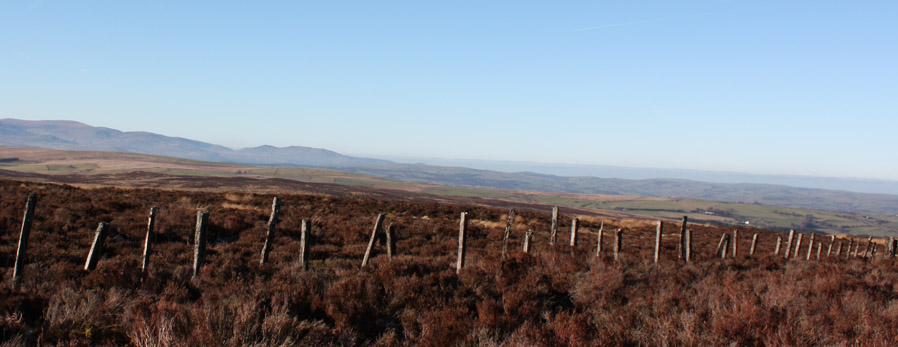
Ranchers, farming the vast expanses of rural mid-west America were largely overlooked by the booming telephone age that came at the end of the 19th century. Resources were poured into connecting up urban areas but the distances were just too great to wire up the sparsely populated wilderness.
Human capacity for ingenuity knows no bounds, however, and a few enterprising ranchers realised they didn’t need to erect telegraph poles and hundreds of miles of cable to use the telephone. They already had thousands of miles of largely contiguous barbed-wire used as stock fencing.
A simple system evolved – hook up a telephone and a DC battery with a cranked magneto to power the ringer and off you go. No need for a central exchange. On this system every phone rings – you just answer the call that uses the code for your farm.
Rain induced short-circuits were a problem as were eavesdroppers reducing signal strength, but this system provided a vital rural link allowing remote families to keep in touch.
This post is an extract from New Scientist’s Christmas & New Year issue, and with the correct password you can read the whole article at “The Wired Wild West“.
Poles in Kazhakhstan
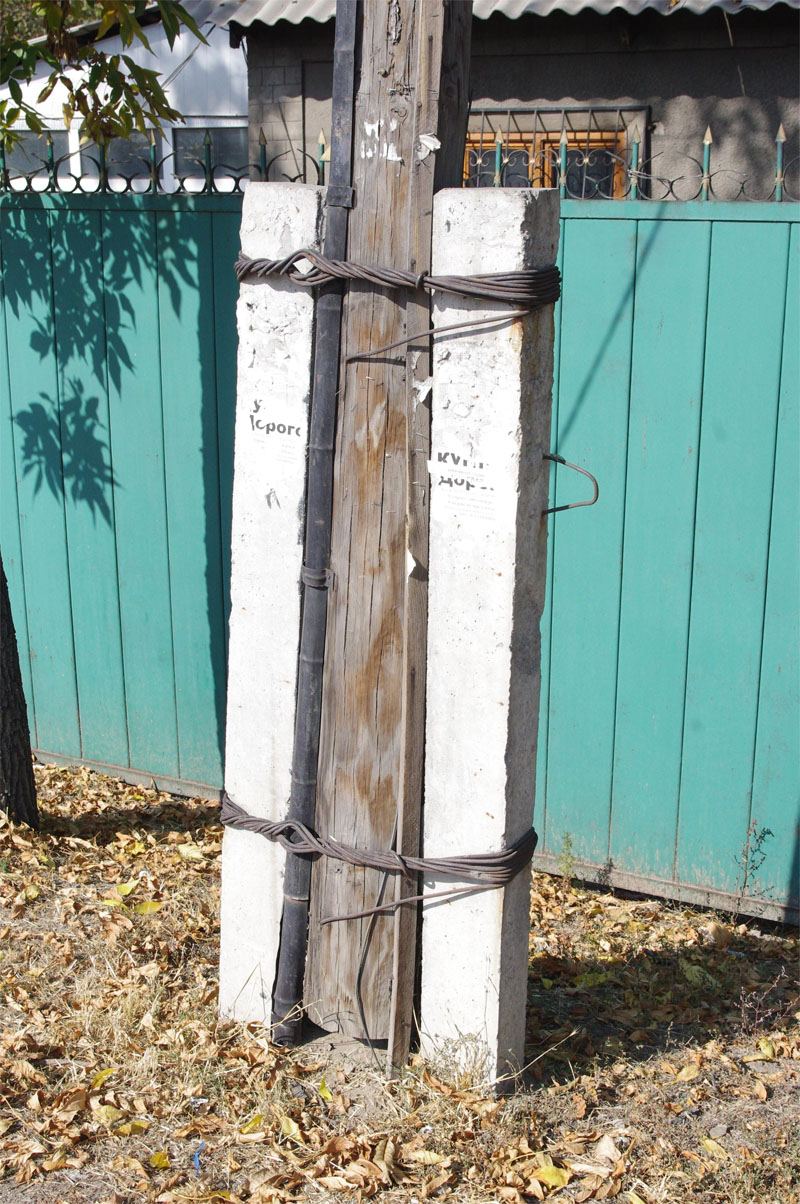
Dennis Keen, an American living in Almaty, Kazakhstan, got to wondering about the utility poles he finds there. More specifically why they use two cement pillars to secure the pole instead of just planting it into the ground. Pictured left.
I replied with a suggestion that there may be a termite/wood boring insect problem in the area. I’ve seen this splinting in photos from other countries – Africa and Oz – and that was the explanation given to me. As always, I took the opportunity to beg photos of interesting poles in this faraway land.
Dennis replied with these gems:
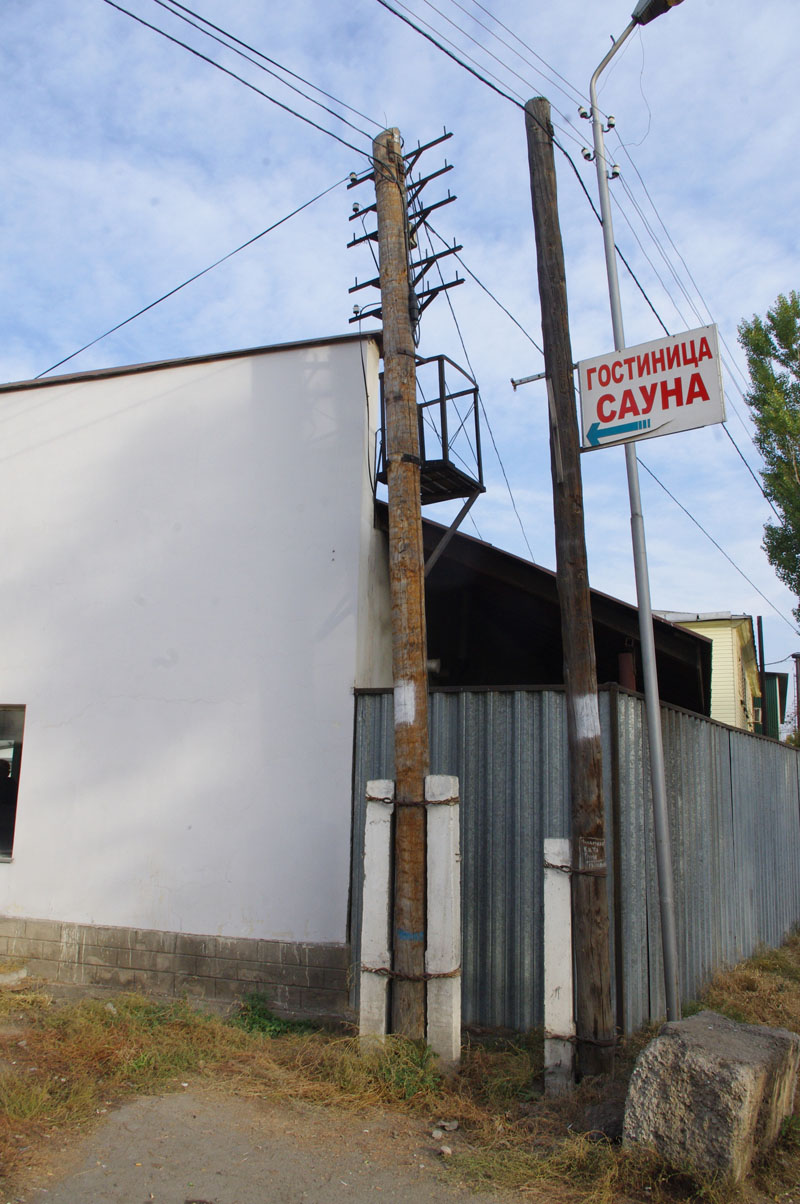
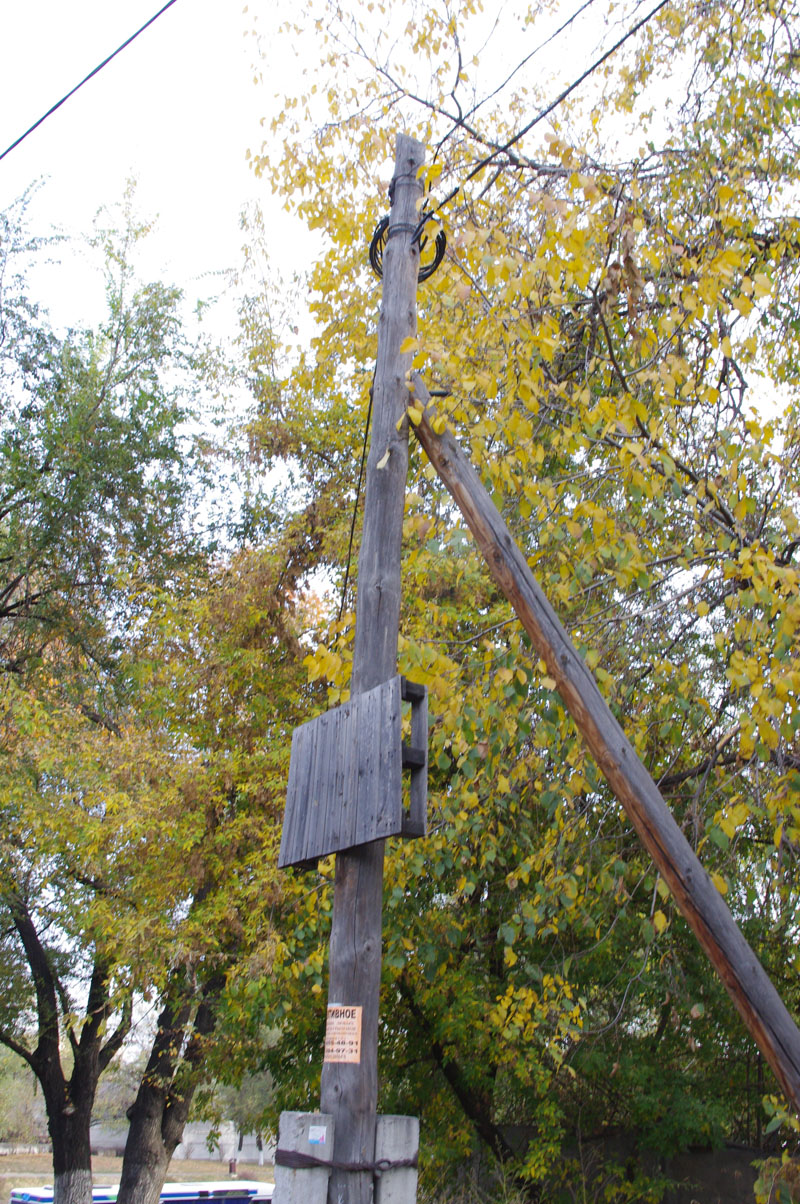
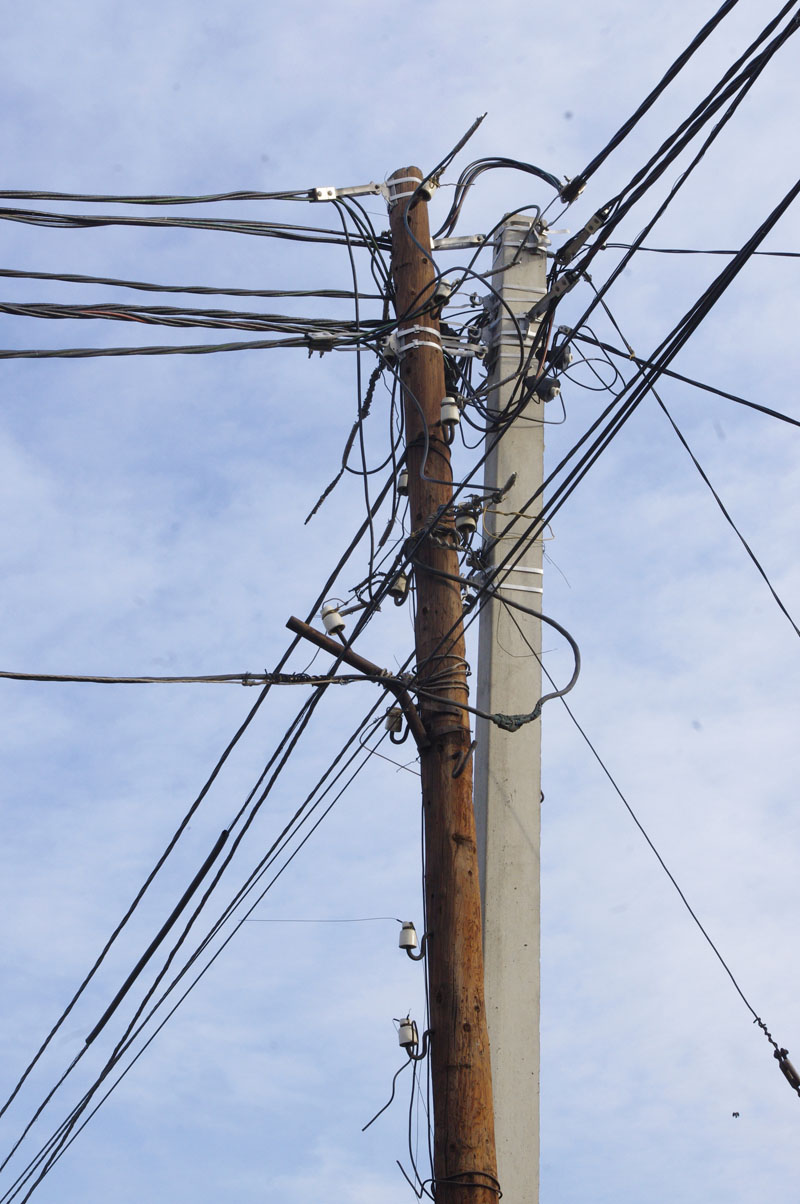
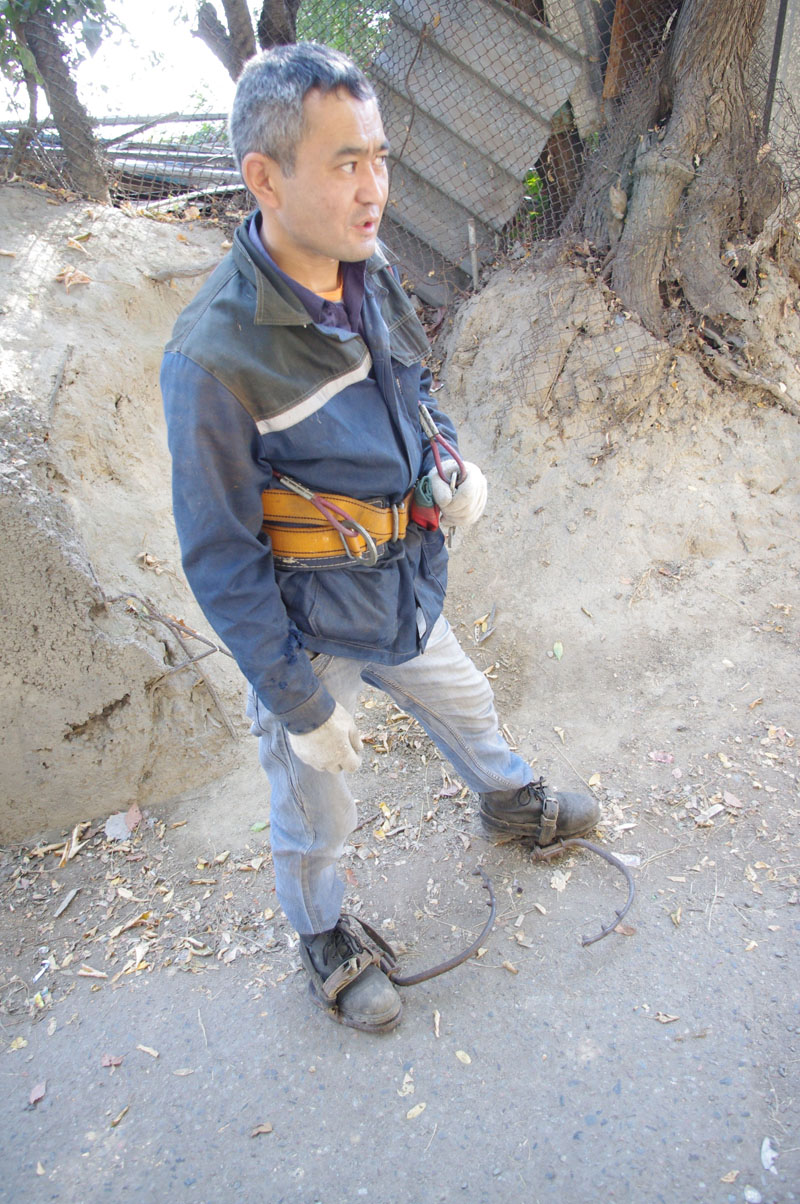
…What interests me is that these poles don’t seem to have after-the-fact splints, put in to shore up rotted or chewed-up wood, but rather seem to have been installed that way – and notice that the wooden parts of the poles are always lifted off the ground by the two cement pillars. When I saw that, I thought it must have something to do with how the electricity is conducted, but I’m an absolute amateur at this stuff and could be mistaken.
I took a few other photos for you today, so you can appreciate more of what Kazakh poles offer.
The first picture shows you the most common form of the utility pole here: concrete supports at the bottom, a small platform halfway up, and an array with about 20 pins and insulators at the top. If you can help me with more observations or descriptive language, I’d appreciate it.
In the second picture, you can see a pole that had these two crate-like things nailed to it on either side of it. I couldn’t figure what they were for, and thought you might have some ideas.
The third picture shows you what a mess the wiring seems to be. This post was near some kind of sub-station, but still, I challenge you to make sense of it.
And lastly, I’m attaching a photo of a lineman I ran into here, wearing his gear. The pole-climbing gaffs are called kogti, or “claws.”Best wishes,
Dennis Keen
So dear readers…
- Is my termite guess correct?
- What’s the concrete splint thing all about then?
- What the hell is that pallet doing nailed half way up pole #2? and…
- Does the sign saying “ROCNHNUA CAYHA” in picture #3 really mean “GOLF SALE” in Kazhak?
Pole of the Month – Dec 2013
What an absolute beauty. As seen by Lord of the Northern Poles, Kev Currie, somewhere between Norfolk and Scotland. Quite possibly on the A68 which nips o’er hill and dale twixt the A1 and yr Alban (as we say in Wales). I know a telegraph pole artist who would like this.

The Kev Currie Appreciation Society
Firstly, my humble apologies for the wretched amount of time between this post and the previous. Due to circumstances beyond my control I have had to contend myself with glimpses of roadside poles as I hurried about the country in vague panic during some familial distress. Alas, I could not find the time to blather on about them to our eager readership.
This post, though, I could put off no longer. You see, we at the Telegraph Pole Appreciation Society have always enjoyed our regular correspondence with Scottish Borders representative, Lord of the Northern Poles, aka Kev Currie. He is an adroit connoisseur, cataloguer and photographer of vintage telegraph poles and his images are among the finest. This month the photos he has sent us almost made me weep with a sort of nostalgic joy. It was either that or the wince-making bank statement I came home to. You decide… In Kev’s own words :
Lord of the Northern Poles checking in with some nice photos from my latest foray down into deepest darkest Norfolk!
We came across these awesome poles with fancy hats on top! and the insulators look like the pole is wearing a crown – all very majestic – Also your members may also like to know that on my return journey we took a diversion over the A68 to get back into Scotland trying to avoid the customs post, and what a treat that was and should be included in your next book – Incredible Pole spotting routes in the UK vol 2
The A68 from the A1 takes a very scenic route over the hills and up into Scotland, but the best part of all is that there is a plethora of weird and wonderful telegraph poles to drool over from metal ones in various colours and stages of deterioration to wooden ones with hats on! and some with cross bars, some with street lights attached! it was like well it was amazing! sadly i had to drive this section so no photos, but I will return to take many many photos!Seasons greetings to you and yours
Kev – Lord of the Northern Poles
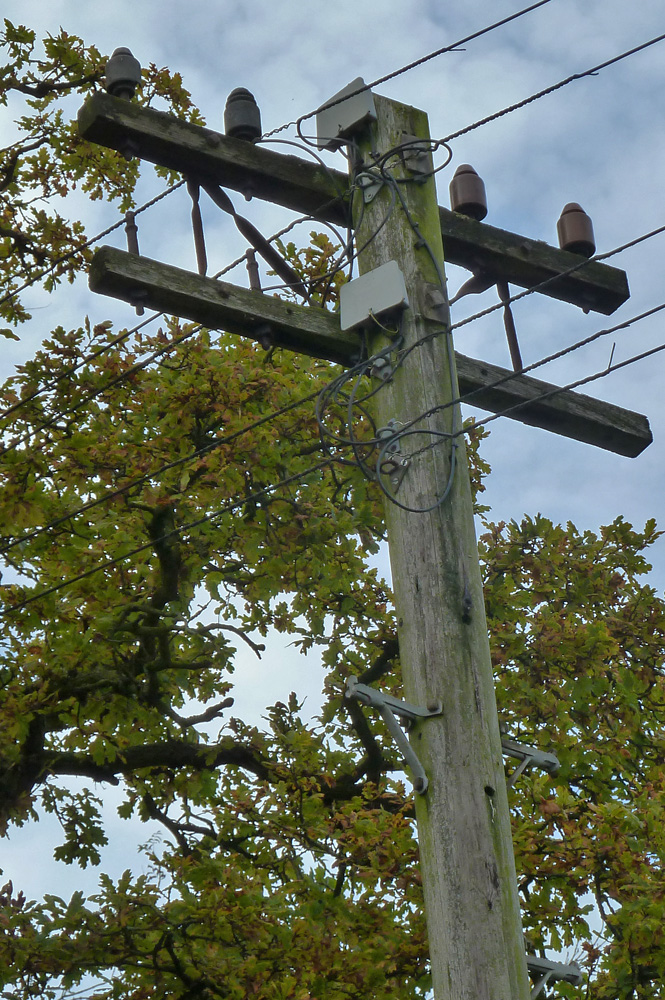
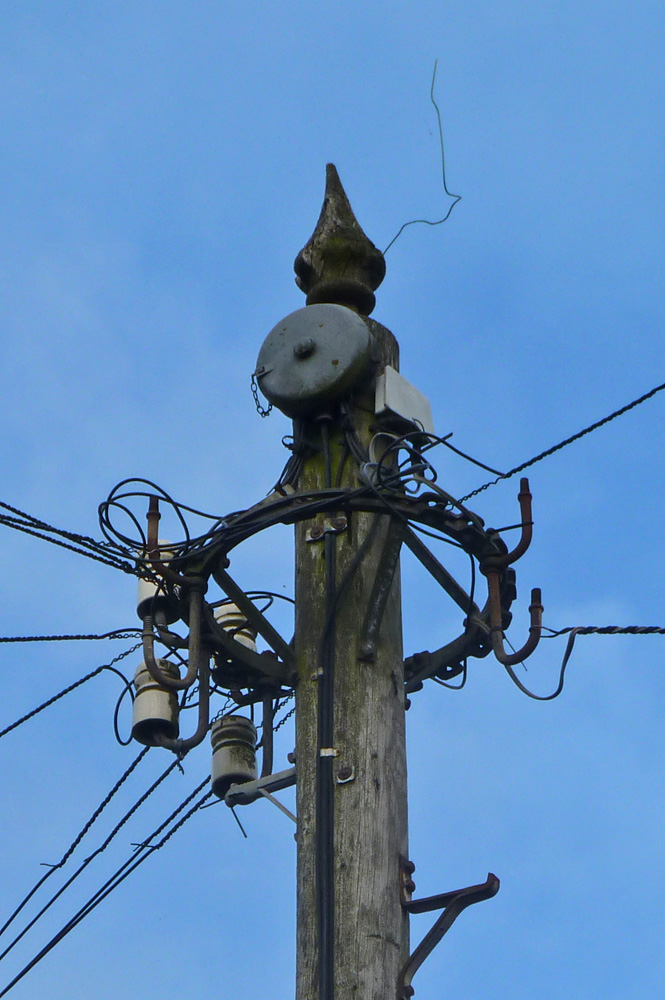
With its finial and sceptred crown that last pole is one of the finest I have ever set eyes upon. And when I get a moment from my immediate mayhem I shall invest it as such on these very pages.
Actually, you may also like to know, and I hope that I’m not breaking a confidence here, but Kev’s missus is actually called Lady of the Northern Poles. You couldn’t make it up.
Dylan Thomas and birthday cake poles.

Simon Natelson-Carter (#0372) has written in to tell us that he recently spent a week in a lodge suspended 50ft above Dylan Thomas’ Boat House in Laugharne, Pembrokeshire. He doesn’t say what particular misdemeanour led to his lodge-incarceration but it couldn’t have been that serious as here in Wales suspension above Dylan Thomas’ former retreats is often used as an alternative to open-prison.
Anyway, while he was there he took a look at The Tin Shed Experience – a 1940’s museum which is conveniently nearby. There his finely-tuned telegraph pole detection gland spotted this telegraph pole–based construction within their grounds. Once satisfied that no pole cruelty was involved in its erection therewith Simon and the museum owners celebrated said pole’s prior loyal service. Though I don’t think this particular pole has done much by way of public telegraph work seeing how it seems to have an ’07 mark.

Simon is also the curator of the Tamsin Pastelle museum in Wiltshire. Some time ago he eluded to further artwork finds by this great telegraph pole artist. Herewith the first. Tamsin’s cake and butterfly period (possibly) followed a poorly-judged fungal foray which led to a plate of garlic magic-mushrooms on toast.
She may have ended up with a gippy stomach and an interesting insight, but we mortals have this colourful, vibrant, psilocybin-induced candle and butterfly filled masterpiece to remember her by.
This and other paintings by the same artist can be bought in greetings card form from the US website Card Gnome.
* As with nearly all images on this website – click to enlarge.
Guatamalan poles and Dollies
Our use of the word “month” to describe our “Pole of the Month” takes this chronological division of time to its loosest possible definition. You certainly couldn’t set your calendar by it. Perhaps I should re-title it “Pole of the length of time since I last remembered to put one up”. Not quite so prosaic.
 Anyway, herewith a photo that was submitted to me as a possible contender for P.O.T.M. And while this is clearly an interesting piece of street furniture – insomuch as it’s a right old mess and it’s in Santiago Atltlan which is in Guatemala – it just doesn’t quite float my boat enough to warrant POTM status somehow. Perhaps it’s that the photo is just of the central gubbins? And that the top is missing, and the bottom; as too is any interesting background. You see, for the true poetry of a pole to come out we need to see it harmonising in its natural environment. So, Simon Shouler – who I think sells houses for a living – thank you very much for taking the trouble to send us your submission, but I’m afraid it won’t go down in history as a T.P.A.S. P.O.T.M.
 On another note, Brian MacDermott wrote to us…
I seem to recall as a young lad (late 1950s, UK) that we called insulators ‘dolls’ or ‘dollies’. Is my memory correct??
Many thanks
Brian
Well, I have never actually heard them called dollies, but I like the idea so much that I’m going to perpetuate this idea. So Brian, the answer to your question is “Yes”. insulators are (from now on at least) called dollies.
British Columbian Poles
The aesthetic appeal of telegraph poles is universal it would seem. This week I received an interestingly attachment- adorned email from Canadian Society member Paul Fisher (#0546). And you can just tell from his words that Paul “gets” telegraph poles.
…I am glad to know that this society exists – I am not alone with my admiration for old telegraph poles.
I have been driving back and forth from Vancouver BC to the interior of BC to visit an old log cabin for summer fun. Along the way I drive past many kilometres of railroad track, much of it still with the original telegraph poles running alongside. Most of the wires from the poles are missing or just dangling along the ground. There are many different coloured glass insulators across the crossbars of the poles (clear glass, blue glass, brown glass, ceramic, etc..).
I have attached two photos… The first one I think is a great look – there are missing insulators, cut wires and broken crossbars, but the pole still holds strong.
The second photo has an interesting red box along the lower crossmember. I was told by the person who was taking care of this site that this was the pole that the train engineer would stop at, and connect his telegraph (using the big black cable you can see coming down from the pole). From here he would signal back to the train controller to update them of their position and receive further instructions.
Both photos were taken at a historic location in BC where the last spike of the Canadian Pacific railway was driven – http://en.wikipedia.org/wiki/Last_Spike_(Canadian_Pacific_Railway)
There were no markings on either of the old poles. I would guess that they were installed at the time that the railway was installed, so late 1800s.
I hope you like them.
Paul


Readers writes
You might be amazed*1 at just how much correspondence this society receives. Actual letters and emails asking about telegraph poles, I mean, not the endless automated drivel offering potions to enhance my, ahem, standing in the community etc.
One question I get asked all the time is just how do you age a telegraph pole. These correspondees have checked our FAQ page and still need to know just when a pole was planted. Possibly they have some boundary dispute with their tiresome neighbour – you know, the one with the endless barking dog who throws their rubbish over your hedge and who slams their car door at all hours of the night. Or perhaps they just like to know the age of things, like the universe, Helen Mirren or that pack of sausages in the fridge. Truth is, other than the “Doby” mark which says the year it was creosoted, I don’t know of any way to tell when it was planted. Presumably a list in the local BT office. I hope now to be advised of a sure-fire way by our many telegraph pole employed readers.
Question two, I suspect, stems from the treasure hunting fraternity…
‘For DP 3081 you must search, the answer then lies in marbled church’
…that sort of thing. Basically, given a DP number for a pole. How do we locate it other than randomly wandering the countryside? I hope now to be advised of a sure-fire way by our many telegraph pole employed readers.
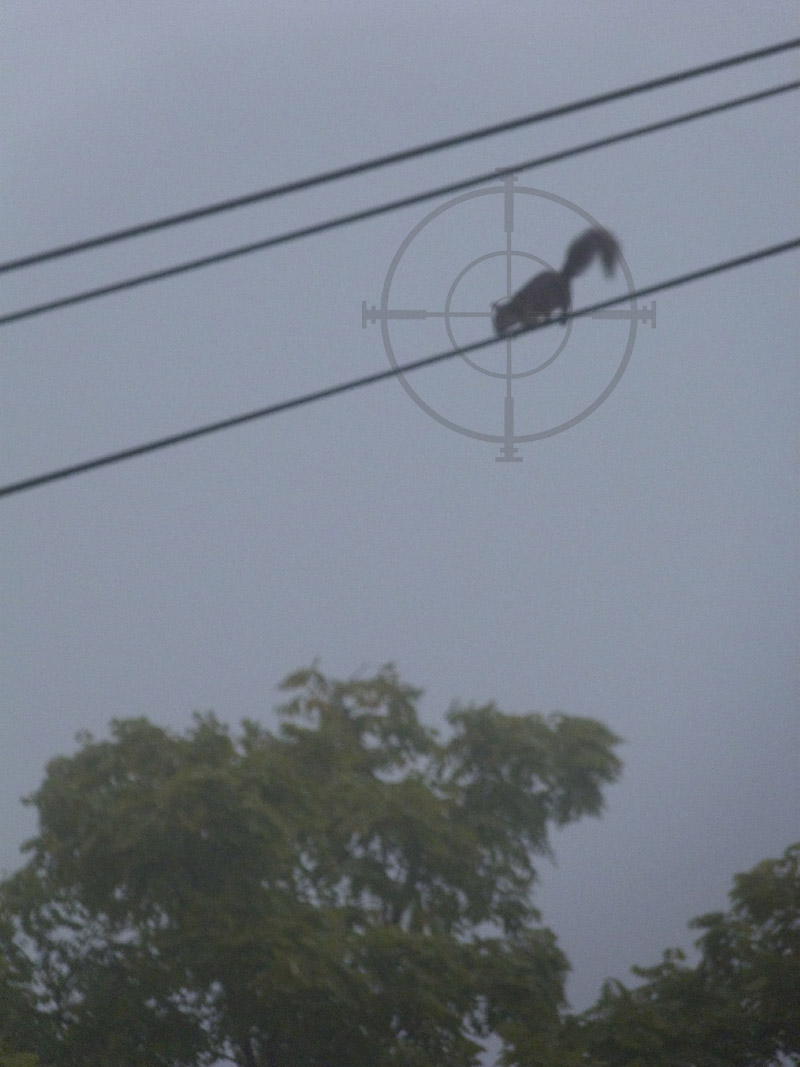
Anyway, here’s some pretty pictures to illustrate all of the above. These were sent in by Andrew Chapman who whilst trying to age a telegraph pole, told me about an elderly pole at a crossing of wires onto Ash Island in the Thames, west London. I imagine if I were to trade my house in I could probably afford the carport of one of these houses. Or part of a carport maybe. Anyway, Andrew told me that the local squirrels use the wire-span as a bridge onto the island. The rifle sights were my addition – I have an issue with the little bleeders.


*1 If you’re the sort who is easily amazed.