Oppenheimer Poles

posted in: History

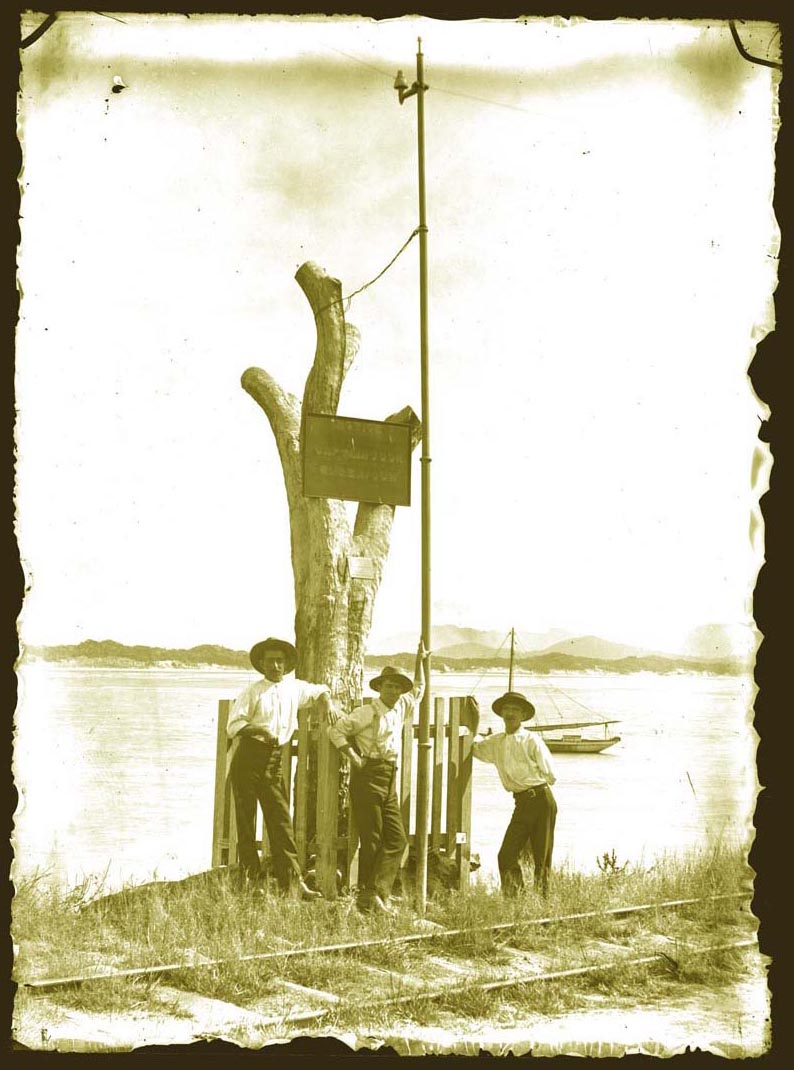
An Oppenheimer pole at Cooktown, Australia, circa 1900 Australians are rightly very proud of their Overland Telegraph Line (OTL).  This was a 3,200 kilometre line that connected Darwin with Port Augusta in South Australia.  Completed in 1872 the OTL allowed fast communication between Australia and the rest of the world.

Initally, the line was supported by Cypress poles, but these swiftly succumbed to termites and bush fires. Oppenheimer poles, were galvanised iron structures, imported into the UK from Germany and from there shipped to the antipodes.  Therein they were placed with an 80 metre spacing and with a repeater station every 250 km.

Many of these Oppenheimer poles are still standing and are much cherished by the Aussie telegraph enthusiast community.  I know all this because I have been in communication with Mike Patterson (VK4MIK) of Tableland Radio Group who recently erected their own Oppenheimer pole at the Mareeba Heritage Centre, Queensland, top right hand corner of Australia.

I previously reported on a request by Norma Warren for any information on the 14 iron poles made by Buller Ltd UK which still stand locally to Esperance, Western Australia.  These, she tells us were the original poles used to link Adelaide to Albany via Ceduna, Eucla and Esperance.   Bullers Ltd were based at Joiners Square Works, Hanley, Stoke-on–Trent by the way. An Oppenheimer telegraph pole recently

The photos alongside were provided by Mike Patterson.  The first is taken at Cooktown in 1900 showing the Oppenheimer pole beside the Cooktown to Laura railway with the tree that Lt James Cook RN tied HMS Endeavour to whilst undergoing repairs after hitting a coral reef in 1770.  The second shows an ‘o” pole still sitting where it was erected in 1876 on the Palmerville to Maytown telegraph line – this photo taken only recently.

Finally, for those interested in reading further the fascinating history of Australia’s overland telegraph…

1. Celebrating 140 years of the Overland Telegraph Line
2. Wikipedia entry
3. The Overland Telegraph by Ron McMullen.  (Document disappeared from original web location – I saved it before it went)

Keighley and Worth Valley Railway

posted in: History

Regular correspondent with this society, Adrian Trainsett Esq, has transmitted to us his latest magic lantern images.  First, of a lovely pole opposite Haworth Station on the Keighley & Worth Valley Railway.  He also, kindly, included two parts of a scan from the pages of that sage tome “British Transport Commission, (British Railways Division) Code of Practice for Pole Line Construction 1957“.  This, we hope, would be of interest to our readers.

Adrian apologises firstly for the low quality of his photograph – this being due, he assures, to his inferior image capturing apparatus – and secondly for his recent lack of communication.

Well, in return I feel an obligation to apologise for our blatant breach of copyright in including said pages without recourse to B.R.C. for their permission.  And secondly, to Mr Trainsett himself for sitting on his communique for the last 8 months.  Contrary to the impressions we give out, our channels of communication are not quite a black-hole and stuff does eventually shuffle to the top of the pile on my desk.

Telegraph pole opposite Haworth Station brs-st1 150 brs-st1 150

As usual, click the image to enlarge.

Communicating Cowboys

posted in: History

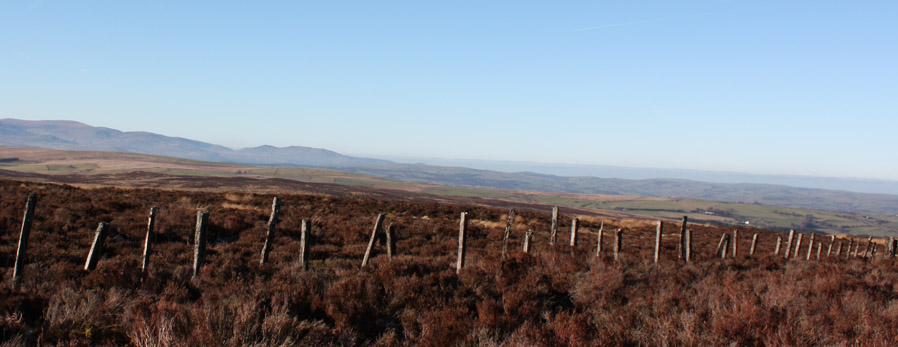
A fence across the Hirathog, North Wales

Ranchers, farming the vast expanses of rural mid-west America were largely overlooked by the booming telephone age that came at the end of the 19th century. Resources were poured into connecting up urban areas but the distances were just too great to wire up the sparsely populated wilderness.
Human capacity for ingenuity knows no bounds, however, and a few enterprising ranchers realised they didn’t need to erect telegraph poles and hundreds of miles of cable to use the telephone. They already had thousands of miles of largely contiguous barbed-wire used as stock fencing.
A simple system evolved – hook up a telephone and a DC battery with a cranked magneto to power the ringer and off you go. No need for a central exchange. On this system every phone rings – you just answer the call that uses the code for your farm.
Rain induced short-circuits were a problem as were eavesdroppers reducing signal strength, but this system provided a vital rural link allowing remote families to keep in touch.
This post is an extract from New Scientist’s Christmas & New Year issue, and with the correct password you can read the whole article at “The Wired Wild West“.

Patron Saint of Telegraph Poles

posted in: History

Saint Clare of Assisi


Yes, ’tis “All Saints” day here on sunny earth. And if things as diverse as “stiff necks” can have a patron saint and also “stamp collectors” and “car parking spaces” then why not Telegraph Poles I asked myself as I awoke this morning.  So once I’d despatched the just-right porridge that Mrs Telegraph Pole had put out for me, it was off to consult my old mate Google.

The nearest I could get to was “Saint Clare of Assisi” – that’s a photograph of her on the left.  And look, if you squint your eyes a bit that could be a single cross-arm Telegraph Pole she’s carrying there – bristling with mediaeval ceramic insulators it is too.  Anyway, apparently, when she was too ill to attend mass an image of the the service would be displayed on the wall of her cell, somehow.  That’s how she came to be patron saint of television.  Which is not a million miles away from telegraph poles if you were to ask me.

Distant Writing

posted in: History

H aving been asked a question about when telegraph poles first appeared I decided to do some research. And for the want of a good book, I trawled the world wide interweb…

I went right back to the birth of the telegraph as a form of communication, in fact to the first use of the term telegraph from the Latin tele meaning distant, and graphos, writing.  I read about the earliest static electricity transmission experiments by Francis Ronalds  and how the technologies improved and matured through the patents of messrs Cooke and Wheatstone to the first poles appearing alongside railway lines ca. 1843 – before then, telegraph cables had been bundles of cotton and tar coated wires contained within iron tube conduits and either buried or suspended just above the ground alongside railway tracks.

Why am I telling you all this – it is all to be found on one amazing website – a sort of eBook called “Distant Writing” by Steven Roberts.  This is a fantastic and detailed history of the telegraph and associated apparatus – including telegraph poles.  Go there and read it now.

Distant Writing - the history of the telegraph

March 5th – Learn from Lei Feng Day

posted in: History

May 5th is Lei Feng Day

Lei Feng - China's exemplary exemplum Commie icon Lei Feng.
The caption translates as:

“Real revolutionaries wear nice hats”

A t this time of year the Zhengzhou branch of WH Smith is awash with greeting cards dedicated to and celebrating the life of Lei Feng.  This retailing frenzy culminates on March 5th, celebrated as “Learn from Lei Feng Day”, when card recipients are urged to live their lives like Mr Feng.

Who hell he?  I hear you ask.  And what’s he doing on our website?

Born of poor peasants in Hunan Province, in 1940, Lei Feng was brought up by the Communist party after his father was killed by the Japanese and his mother killed by herself. He then went on to join the People’s Liberation Army, became a squad leader and a super-diligent member of the party.

“Yes, but what’s he doing here?”

His study of the works of Chairman Mao taught him to live a life of extreme obedience, frugality, selflessness and devotion of his body and soul to the revolution – wanting nothing more than to be “a revolutionary screw that never rusts”.

“Will you please just get to the point!”

He is a cultural icon, a beacon of altruism and a concentrated expression of communist ideals. All of which came to an end at the tender age of 22 years when he was killed by a telegraph pole.  Yes, China’s courageous guiding light, their moral exemplum, their Prince Edward,  was squashed as his friend Qiao Anshan backed a truck into a telegraph pole which fell on to the poor chap’s head.

Learn from Lei Feng – Beware, the lethal combination of reversing trucks, telegraph poles and feelings of impending fate.

Telegraph poles can kill!  Be careful out there.

UK’s most remote telegraph poles

posted in: History

Telegraph poles on Foula, west of Shetland


These have to be the most remote telegraph poles in the UK.

They are on the Isle of Foula which is way out into the Atlantic some 20 miles to the west of the Shetland Islands. Foula is arguably the UK’s most remote permanently inhabited island.

The poles used to support a ‘VHF ‘Rhombic’ aerial that provided the telephone link from the exchange (the little building) to the mainland before being replaced by the microwave link. 

The photo was sent in my Ian Jolly*, who tells us that he left home in North Wales on a Monday morning and travelled continuously (including throughout the night) finally arriving there on Wednesday evening. A journey of some 700 miles including nearly 300 miles by sea.

He tells us:

This is a single pole that is more remote as it is on the western side of the mountain in the background. It is the last pole on a route that took a single telephone line across the island to a lookout post from a submarine cable that came from the mainland of Shetland during WW1.

The public telephone service didn’t appear on Foula until the late 1930’s when a single line to the Post Office arrived. The telephone exchange arrived in the early 1970’s and its recovery for my collection was the reason for my visit. It was still clicking away in service after BT had had their ‘Last Electro-Mechanical Exchange’ ceremony but they didn’t know it was still in use. they were still dialling two digit numbers to reach each other and had untimed local calls! 

You can hear a little about it by dialling 01595 70 8222 where you’ll hear the sound track from the video I took as it was being changed over to digital working.

*Ian Jolly is one of a collective of enthusiasts who restore and maintain, in working order, a replica of the mechanical GPO telephone network. More of which in coming posts.

More from Kempley

posted in: History
Keith S**** Honorary Technical Adviser Telegraph Pole Appreciation Society E ver determined to find out about the telegraph pole adjacent to the phone box in Kempley (Glos) they have sent us some more photographs.  These arrived after our Society wise man, Keith S**** (H.T.A. T.P.A.S*) had spoken.

Not much to add to your comments on the above, but this pole was grown in the U.K. I can tell by the wide spaces between the rings. I would guess that it is Scots Pine, it does not have the characteristic roughness between the rings of Douglas Fir (could possibly be Larch but not likely as they were not that common)

Telegraph pole in Kempley, Gloucestershire Telegraph pole in Kempley, Gloucestershire

Visit Kempley (Glos) for the purest whitest skies in the world

* Keith S**** is the Honorary Technical Adviser to The Telegraph Pole Appreciation Society. What he doesn’t know about telegraph poles could be written on the back of a co-operative saving stamp – still leaving ample room for everything that I DO know about telegraph poles.

Keith has since added that he thinks it is of the species Larix Decidua(Larch). We’re proud that we have only the best people advising us here at the Telegraph Pole Appreciation Society.

The Dating Game

posted in: History

W e get some odd requests here at Telegraph Pole Towers.  Mainly to stop playing the drums in the middle of the night. And if we don’t stop our bloody dog barking something really bad is going to happen to it. But also occasionally proper requesty stuff about telegraph poles.  Such as this one from Ian Hopkins of the Kempley Tardis Project.Kempley Tardis Project

We would like to input more info on our website and would love the history of the telegraph pole adjacent to our telephone box on Kempley green (Phone box at Kempley Green:: OS grid SO6729)

Please can you help?

Being unfamiliar with said telegraph pole, or Kempley or even Gloucestershire, I asked Ian for a photo or two which may aid our telegraphic forensic department in dating the pole.  He never furnished me with a top to toe photo, but we do have a close-up of the markings at the 8ft mark and some of the head of the pole itself. 

I’m also nothing if I’m not thorough. So I drove down to Kempley in the middle of the night and cut down the pole for the cross-section photo you see lower right.  This should further aid the aging – about 20yrs old when it got turned into a pole, according to me.

kempley green telegraph pole kempley, gloucestershire cross-section of telegraph pole

Alas, the numbers top left only tell us that it’s a Distribution Pole and and is number 37 in the sequence.  The hole punched green ticket above it might have told us when it was last inspected, but those numbers have faded to nothing.  There looks to be a couple of grey ceramic/bakelite screw-top insulators, but all long since superceded by modern BT plastic boxes.

Not being a telephone engineer, or any kind of engineer, or indeed any kind of anything, I will throw this question to the many former GPO engineers who frequent this site (HTA, TPAS Keith S**** among them) who will likely (definitely) know more than me.

OTY chaps.  What can you tell us about the telegraph pole of Kempley Green?

March 23rd 2009

posted in: History

This was the day our late founder, Sir Benjamin Spoon BEM re-incarnated to attend a prestigious football event in the Blue Square Conference of Great British Footy. This game between Wrexham and Kidderminster Harriers was a must-win contest for both sides.

As it happened, those bounders from the West Midlands went home with all 3 vital points due to a 94th minute flapping of handbags in the Wrexham defence. Much jeerification followed.

After the game, Sir Benjamin hung around the bar answering questions from bar staff regarding how much ice to put in his whiskey. He also took the opportunity to mingle with curious onlookers, getting meithered by a couple of kids as well as generally being stared at in a mouth-agape sort of fashion. Then, as quickly as he arrived, he disassembled himself back to his Denbighshire graveyard where he’s spent the last 150 years.

Sir Benjamin enjoying a cigar on the touchline prior to the gameEnjoying another, or possibly the same cigar alongside the last person who ever knew where the bloody net was at Wrexham, Gary Bennett.


(Left) Sir Benjamin enjoys a cigar on the touchline prior to the excitement of the game. Seen here with his gentleman assistant, Huw Thayer.

(Above) Enjoying another, or possibly the same cigar alongside the last person who ever knew where the bloody net was at Wrexham, Gary Bennett.

Also seen alongside is someone with a severe skin disorder and hideously deformed head.


Sir Benjamin, his servant and the players prior to the match

Wrexham captain, Ashley Westwood, listens intently to tactical advice imparted by Sir Benjamin.
Had they heeded said advice, the result would have been a resounding thrashing for the opponents.

 Sir Benjy with the after-match champers.  What what!


Definitely not the same cigar, surely. Sir Benjamin cracks the first of many bottles of champagne. A defeat is only a victory backwards after all.


 Sir Benjamin with man of the match, Andrew Crofts, and man-servant Huw Thayer.Sir Benjamin offers to clean man of the match, Andrew Crofts’ shirt of all the felt-pen scrawling.
Or rather, his manservant, Huw Thayer, will clean it. And in his own time too.

Associate members of the Telegraph Pole Appreciation Society

Associate members of the Telegraph Pole Appreciation Society gather to applaud the decision to wash said shirt.
You can become a member of this august organisation by clicking here.


1 2 3 4