

These much ignored pieces of rural and urban furniture finally have a website of their own.
 This is not the site to visit for technical information pertaining to telegraph poles. You'll find nothing about 10KVa transformers, digital telephone networking or even so much as a single volt. This is a website celebrating the glorious everyday mundanitude of these simple silent sentinels the world over. We don't care what the wires contain either. They all carry electricity in some way be it the sparky stuff which boils your kettle, or the thinner stuff with your voice in it when you're on the phone.
Isle of Wight Telegraph Pole Project.
 Regular readers of these fair pages may remember our insulator appeal on behalf of the Isle of Wight Steam Railway. Well, we’ve had the following letter from Stuart Duddy telling us of their progress:
Hi Martin
I thought you might be interested to see how our project to reinstate the telegraph route along our railway line is progressing. The following link summarises the activities which took place during a couple of weekends in November: <Telegraph Pole Project Summary>
As a result of the appeal which you kindly placed on your website on our behalf, a couple of your members contacted us regarding insulators. A young chap named Jake Rideout (from Somerset, I believe) visited us back in August with a tray of approximately 50 ceramic insulators and we were recently contacted by another of your members, Ian Bristow who lives in Lincolnshire, and he seems very confident that he can also assist, possibly with about 200 insulators, which is most encouraging.
With kind regards
Stuart
Just goes to show what wonderful people telegraph pole appreciators are – well done to Jake & Ian.
Ghosts of lost poles
Society member #0620, John Cranston, was gifted membership of our elite group for Christmas last year. This, he found, was a life-changing present. Now, John is a regular correspondent to these pages and has as recently as 10 months ago sent me these pictures and the accompanying text. It is late on a Wednesday night and I feel I may be quicker to the pub if I just post John’s words here almost verbatim. Besides, I couldn’t explain what this is all about any better than he.

Dear Telegrafenmastdirektor (as they might say in Germany but probably don’t *1),
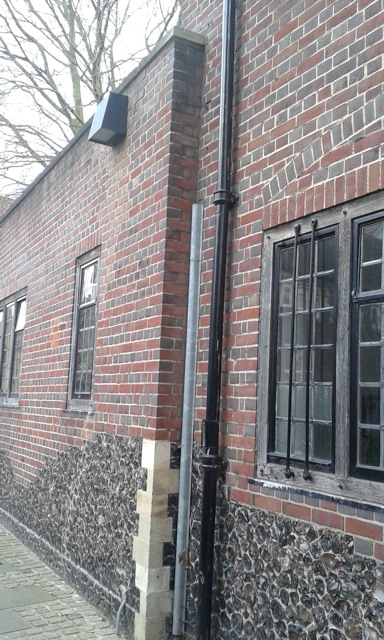
This appears to be an old label from a distribution pole. I’ve only seen one other like this, on a pole dating from 1909. Later poles seemed to have metal numbers hammered into them so, what do you reckon, pre-WW1?
Then what’s it doing on a wall up St Clement’s alley in the middle of Norwich with no pole in sight – especially as it’s on a building dating from 1938?
Well, it’s next to a piece of metal ducting which clearly once carried a telephone cable (there’s a BT inspection chamber near its base).
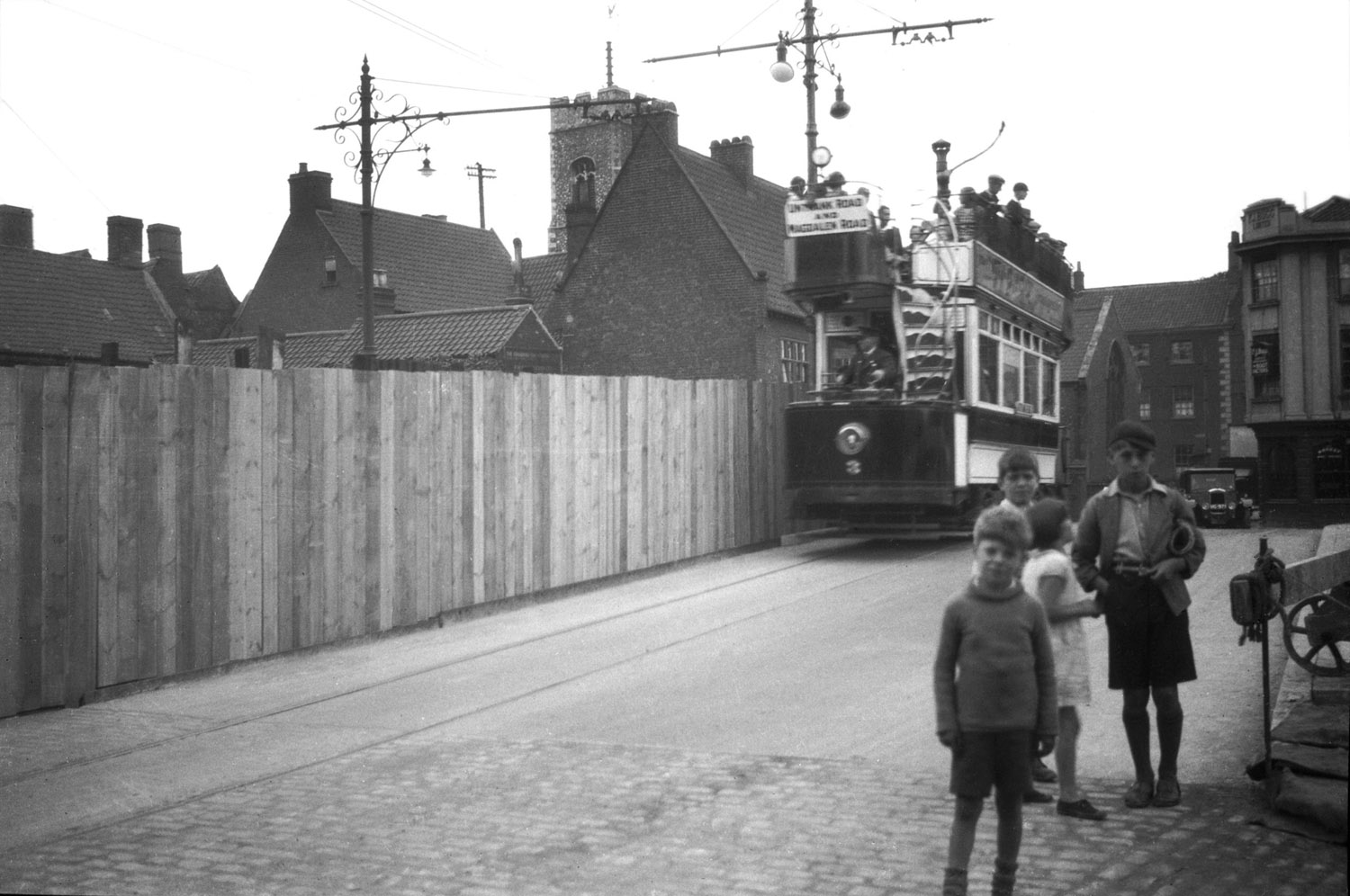
And, hey, old photos show a distribution pole once stood nearby. This picture shows it in 1933.. to the right of the streetlamp.. poking up above the rooftops.
I like to think that when it was removed – possibly in the late 30s – the engineers simply nicked the label off the pole and bashed it into the wall to mark the replacement distribution point.
It’s amazing how being given a membership to the TPAS for Christmas suddenly makes you so much more observant.
And just to let you know my TPAS mug is breaking in nicely. A few more hundred cups of Lidl Knightsbridge Red (the FINEST builders’ tea on the market) and it’ll have just the patina I want.
Feel free to ignore this email in its entirety. *2
Humbly,
Hash 0620 (I don’t know where to find the hash key).
Brilliant sleuthing J. C. #0620. Keep up the good work.
*1 They do actually.
*2 We managed for a full 10 months.
Pole of the Month – December 2015
Sincere apologies to Malcolm Hindes who probably*1 checks back here on a weekly basis to see if I did anything with the photos he sent me back in August*2. Yes, of course I did, they’re right here.
Poles of the month?
I spotted these three poles alongside a minor road near Harlaw Hill, east of Alnwick in Northumberland. Perfectly ordinary dropwire is replaced with individual, insulated conductors where it passes under a power line (probably 33kV judging by the insulators). It’s the use of individual brackets and a seemingly random mix of plain and “jam-pot” insulators that makes them so striking. It was a warm day but not so hot as to account for the low hanging wires.
That’s all very well and technical Malcolm, but from the connoisseur telegraphpoleographer’s point of view – they’re simply gorgeous and well deserving this special Yuletide Telegraph Pole of the Month. Cheers Malcolm, love TPAS.


*1 He probably doesn’t.
*2 This is something I seem to say a lot.
Square poles and the spy who came in from the poled.
Our telegraph pole surveillance network runs wide and deep. Disturbing images just in from our agent in the field, codename “Ectoplasm” show power companies experimenting with laminated, square poles.
We hope you’ll excuse the relative low resolution of these photographs. Agent Ectoplasm used a camera concealed within his butty* box to sneak this latest intelligence back to Telegraph Pole Appreciating HQ. Ecto (as he’s known to his pals) needs to find a better place for his camera, because surely they’re going to get suspicious with him waving his butty box around like that to get these pictures.
We’ll be passing these photos higher up our chain of telegraphular command to see what our boffins make of it. Should we be worried? A quirky anomaly in pole land or the start of something more sinister?
Good work Ectoplasm, we’ll carve your name with pride.


*lunch/snappin’/sandwich depending on where you’re from
Street hardware revisited.
We’re side-stepping our remit a little here: tall, wooden, sticky-uppy, got wires coming out the top. But here is a subject we’ve touched on before and seems to fascinate our listeners. You will in no way remember these articles from 2012 on GPO Street furniture and More street furniture.
Well, Chris Payne, was digging around the internet, as you do, after he found this street marker set into a wall in Tring. He found our pages, but also this one from the Secret Scotland blog. Now, he says this G.R. marker is on the B4635 roughly where the Western Road changes to Western Road. But then Western road is already called Western road and I wonder did he mean to say it changes to something else. But I’m too polite to write back and ask him and I certainly hate to correct someone. It’s this anxiousness to please, to not offend, to be all things to all people that means I drink a bottle and a half of Gaviscon a day. Anyway, so it’s on the B4635 in Tring. And it’s got G.R. on it and I’d like one in my garden. Thank you Chris.

Radials in New Cross Gate
Please forgive my absence from these pages of late. Running a major international Telegraph Pole Appreciating organisation such as ours can take me away from my desk for lengthy periods. However, I’m back now and have tales to tell and photos of poles telegraph to share.
I might also add that we’ve been on the radio a bit just lately. First on BBC Radio 5 Live who were doing a feature on “dull” pastimes. I don’t know why they thought to contact us. Anyway, the BBC’s politically correct remit required them to tick the female demographic checkbox and so they insisted on speaking to my wife, aka Mrs TPAS. She put them straight on a few things, especially the fact that, until then, they may have bracketed us as dull. Our second radio appearance was on the breakfast show of Heart FM. I have no idea when that went out as it was pre-recorded, and getting up in time for breakfast is something which happens to other people. Anyway, apologies for not letting our readers know in advance either by twitter, this website or our facebook page. But hearing my recorded voice makes me cringe, so goodness knows what it must do to anyone else.
Anyway, back to the telegraph poles. Chris Furby wrote to us recently enclosing these two photos. They are, he says, the best of three in the New Cross Gate area of London. Radial Distribution at its very best. Thank you Chris. Hearing from Chris Furby however, reminded me that my daughter once had a mechanical battery powered talking teddy bear toy called a Furby. It was a sort of animatronic thing which once first out of the box slowly learned to speak English. Anyway, I came home one day to find that her elder brother, Tom, had skinned the thing alive and it was sitting there shivering in its metal skeleton. But it’s language had come on leaps and bounds… “Shut the sodding door” it said as I came in, “it’s bloody freezing in here”.


Telegraph Pole Appreciation Day
Due to the recent Red giant super moon, Telegraph Pole Appreciation Day is late this year and is on October 1st.

October 1st
is
TELEGRAPH POLE
APPRECIATION DAY
get outside and….
hug a telegraph pole
take a photgraph of one
climb one
write a poem about one
admire one
print off the postcard on the left
and stick it to your wall
then…
mark this date in your calendar
(normally 21st September
and no, we didn’t forget)
of leaning poles and other animals
Intermittently regular correspondent, David Kendrick (#0609H) has explained his recent dearth of communiques. Not a sign of incipient polophobia he assures us. By way of proof he has sent us the picture you see below of the leaning pole of Morville (Salop). Found in the village hall car park. Morville being famous for a book my wife once read called “The Morville Hours” by Katherine Swift – about a garden I got dragged around a couple of years ago. My sulk lasted almost a full week after that. And “Salop” being ye olde name for the county of Shropshire. People like me, and David Kendrick I presume, refuse to give it it’s modern name much preferring the owd word Salop. Salop, being the county wherein I also formed a society to maintain a stout postulation of Phlogiston theory.
Anyway, David Kendrick, no, this could never qualify as a Pole of the Month because it has its head buried in the hedge. We like to see its face.
The second photo he sent us is of an array of pole engineers’ climbing equipment at the Kidderminster Railway Museum where he is a volunteer archivist and trainee boring old fart. I can’t help but wonder what one goes on to be once graduated from this latter training course.
With regard the second photo. Through the wonders of internet technology, if you look away from the table full of tools for 10 seconds, then look back again, you will find I have removed one of the items. You pass the test if you can tell me which one it is.


West Somerset Railway
Highly irregular regular correspondent to these most fair pages, Willie Montgomery Stack writes and and encloses photographs…
Sir,
Members of the TPAS East Dorset (2015) branch – not to be confused with any previous grouping or organisation bearing the same name – paid a visit to the West Somerset Railway on June 4th, cameras at the ready.
One member was flashing away furiously for the entire 75 minute journey on the old Great Western branch from Bishop’s Lydeard to Minehead. The rest of us were just happy to take photographs.
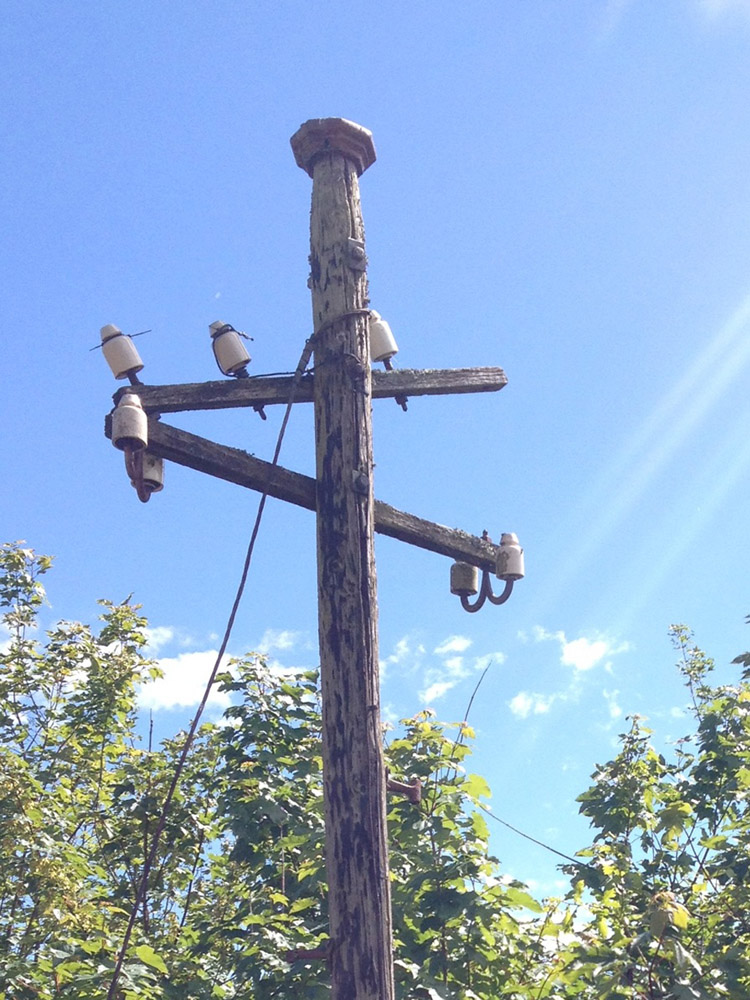
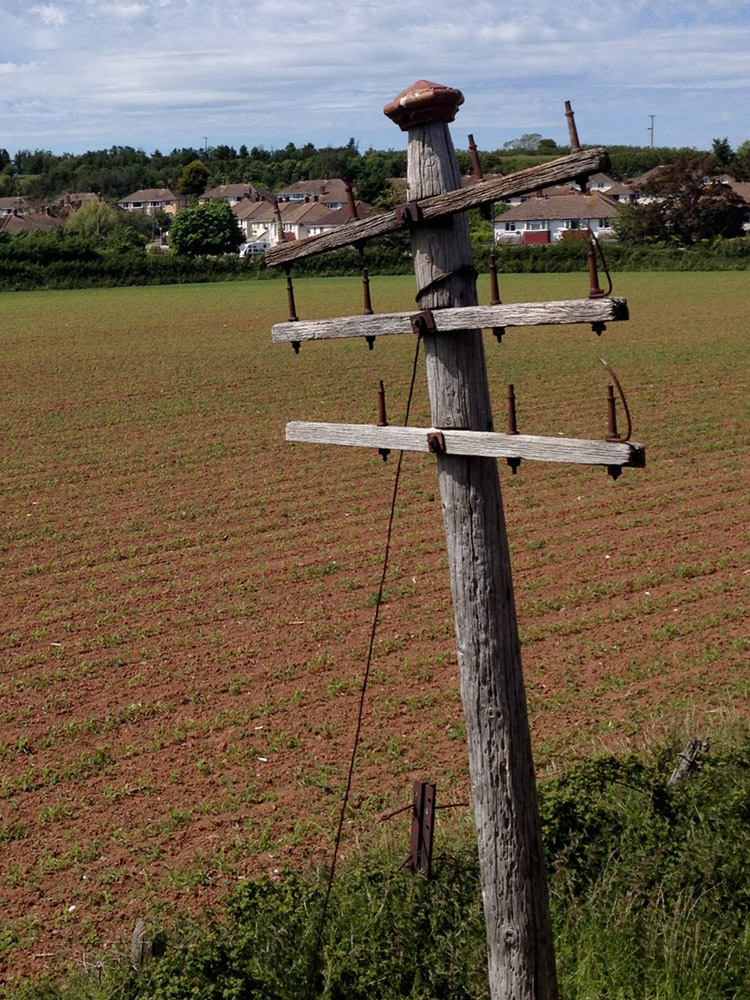
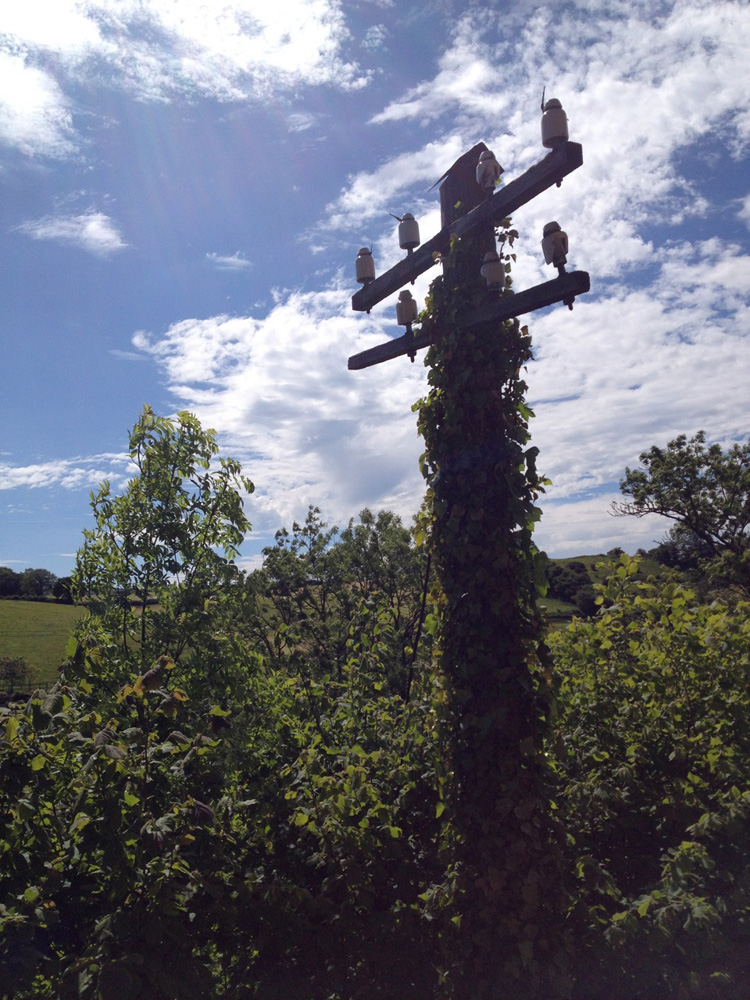
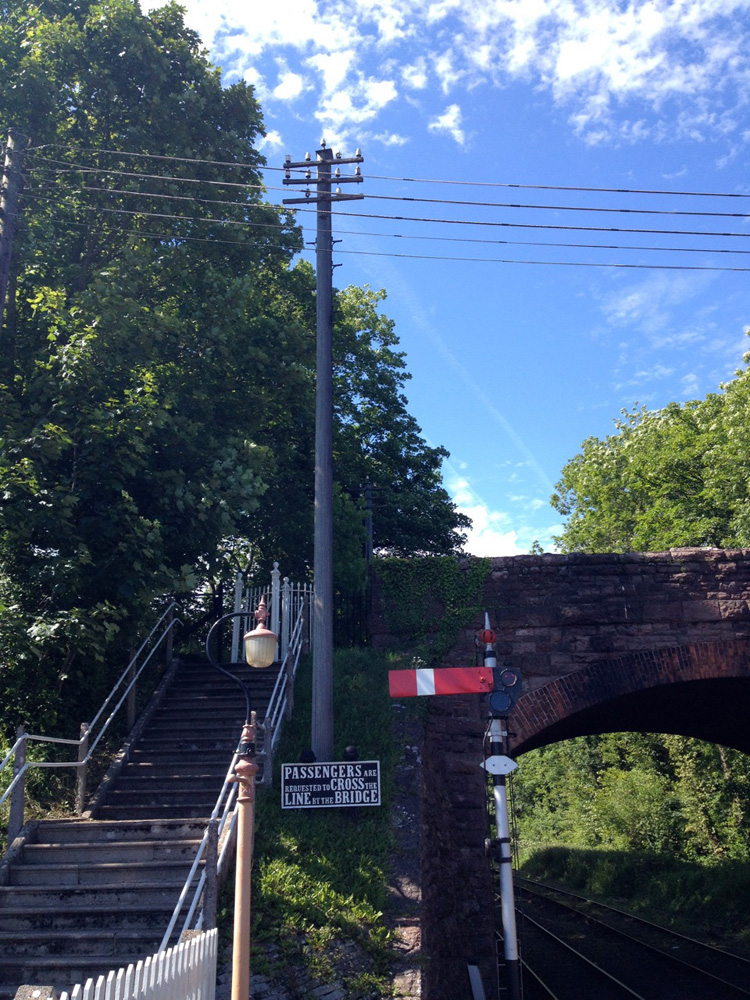
And look what we saw when the prints came back from Boots this morning – some very unusual finials on the top of several of the track-side poles, eight-sided and with the poles themselves apparently tapered to make them fit. (Photos 1 and 2 below).
Have you ever seen the like? We would appreciate it it you could bring this to the attention of the wider society – nay, perhaps even to society in general!
Yours,
WMS
An enthusiastic professor of telegraphpoleology
Jake Rideout can be considered a true connoisseur of the telegraph pole. If this were a learned establishment then he would surely be revered as a professor. Alas, whilst we are just as esteemed as the highest academic institution, we have no sort of hierarchy whatsoever. So hard luck there Jake. Anyway, I have sat on these photos of his in my publication queue for long enough. It’s a rare thing for me to receive photos of interesting poles and then also to get such high quality information about them too. Please read all about Jake’s insulator collecting exploits by visiting his website jajainsulators.com.


1: Small crossarm pole near the A362 at Frome. Has still in place two porcelain No.1 ‘cordeaux’ and a saltglazed No.3 insulator. The bracing span on the right have came loose as it is supposed to be supporting the top crossarm on the left hand side. The pole as been replaced.
2: ‘Ring’ pole in Frome next to a low voltage power pole with ABC cabling. The ring pole has 8 (One behind the pole) No.16 ‘screwtop’ insulators, one missing it’s lid. This pole has also been replaced and the telephone cables tied onto the power pole.
3: High voltage (33kv) electricity pole with six powerlines and a total of 38 insulators. This is a pole on one of two high voltage routes which terminate at the small sub station in Frome. (Extra info: On the right hand side, the top two cables are supported by brown multipart insulators after connecting to the suspension insulators. This is done so that the lines don’t hang down onto the guy wire which can be seen. This is standard action on all poles which change direction.)
4: Ring pole on Locks Hill (Frome) with composite No.16 screwtop insulators, the two on the left in use with the original bare cables.
5: Abandoned pole next to the original trackbed of the Somerset and Dorset Joint Railway (S&D) just outside of Bath. This pole contains a small variety of insulators including some rarer Midland Railway ‘corrugated’ insulators.
6: Low voltage electricity pole near Radstock. This shows what would have been an older installation. The ABC cable on the right has replaced 5 un-insulated cables which would have been tied to the horizontal row of insulators, and then continue as 5 un-insulated cables tied to vertical insulators like on the left side. I don’t know whether this is correct, but the horizontal cables are not so common and I believe are used over main roads. I had a week’s work experience with an electrical engineering company and was told that the cables have to be over 5 meters above the road as not to foul high vehicles. I believe this set-up was used to raise the height of the lines.